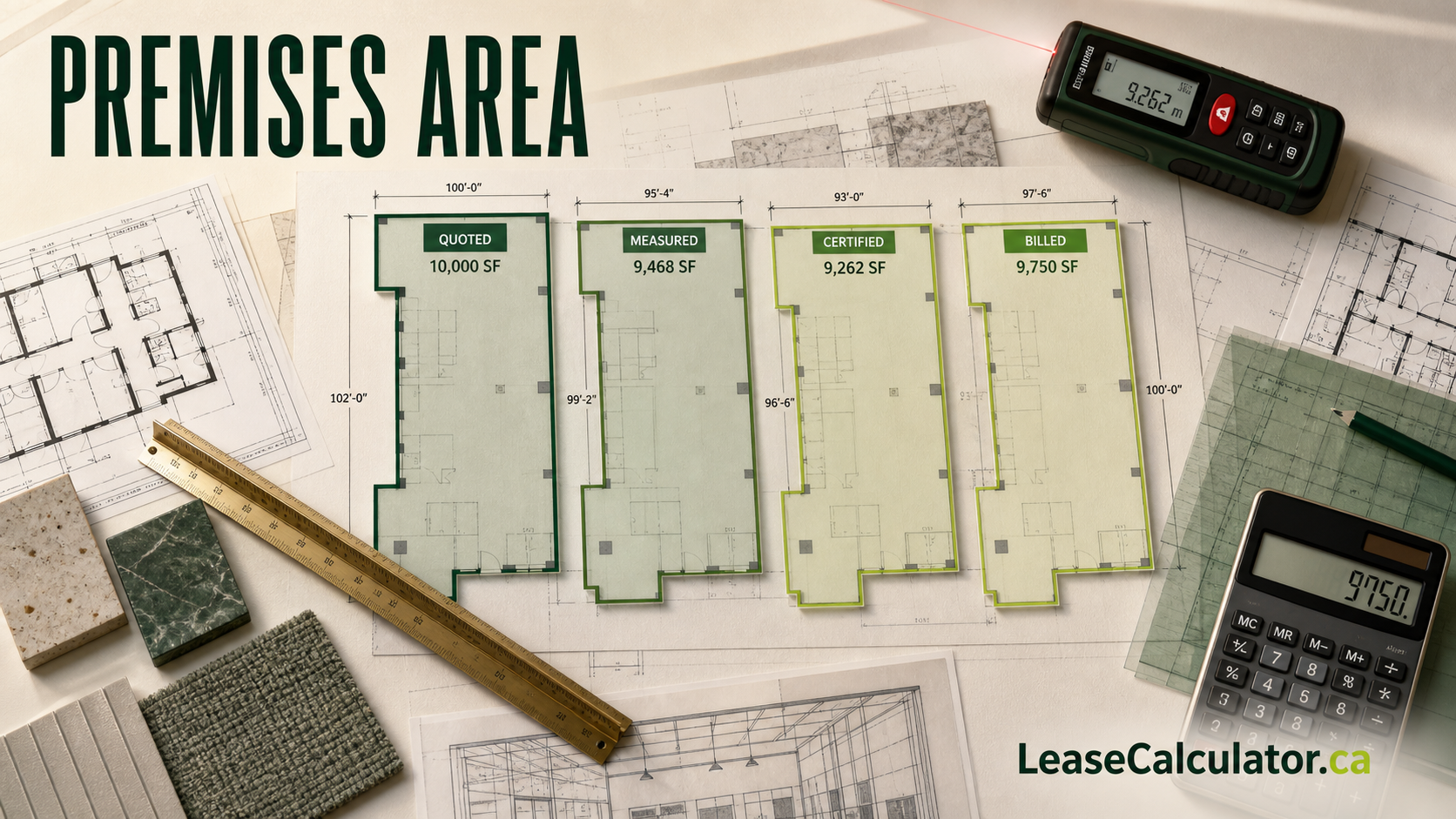
What this means for the deal
- Use usable or occupant area to test operational fit and rentable or lease area to model the entered economics.
- Calculate an observed load-factor relationship only from supported areas for the same premises and measurement framework.
- Compare options on both dollars per rentable square foot and total dollars for the operational area delivered.
- Verify what shared areas, amenities and service components are included under the selected measurement method.
How much space can the business use—and how much area is priced?
A space can be operationally efficient but carry a larger rentable allocation. Another can have a lower asking rate but deliver less usable capacity. Looking only at the rate per rentable square foot hides both differences. Build the operational program first, then reconcile the area used for lease pricing.
For every candidate, keep usable or occupant area, rentable or lease area, total annual occupancy cost and the important physical criteria together. The goal is not to minimize one ratio. It is to understand what the organization receives and what it pays under a controlled definition.
A load factor is a relationship—not a universal market constant
When supported usable and rentable areas are available for the same premises, dividing rentable by usable and subtracting one produces an observed percentage relationship. That can help compare how much additional area is allocated beyond the selected usable basis. The result remains dependent on the measurement standard, building configuration and area definitions.
Do not apply a generic factor to certify an unknown rentable area. If a listing shows only rentable area, request the supporting floor plan, measurement basis and usable or occupant-area information needed for the operating decision. If two options use different standards, disclose the mismatch rather than ranking the ratio as though it were perfectly comparable.
Office, industrial and retail space need different questions
Office comparisons often focus on occupant or usable area, rentable area and shared floor or building components. Industrial premises may require careful treatment of warehouse, office, mezzanine, shared service and multi-building conditions. Retail analysis may use gross-leasable concepts and still require separate review of storage, service, patio, common-area and percentage-rent provisions.
BOMA maintains property-type-specific measurement standards, while IPMS: All Buildings provides an international framework across building uses. The correct instruction depends on the assignment and lease—not merely the label on a marketing brochure.
Put area efficiency beside total occupancy cost
A useful property comparison includes the supported usable or operational area, rentable or lease area, annual base rent, estimated additional rent, separately priced items and total entered occupancy cost. It also records whether the required people, inventory, customer flow, loading, parking, accessibility and growth actually fit.
Normalize term, concessions and escalation timing before comparing. A lower rentable rate can still produce a higher total cost, and a smaller load-factor relationship does not make a poorly configured space operationally better. Preserve both the numbers and the fit evidence.
| Measure | Question answered | Do not confuse it with |
|---|---|---|
| Usable / occupant area | How much selected space supports the occupier? | A certified lease billing area |
| Rentable / lease area | What area may drive entered rent? | The amount the business can efficiently use |
| Observed load relationship | How do the two supported areas relate? | A universal building-efficiency rating |
| Total occupancy cost | What does the entered lease path cost? | The advertised base-rent rate |
| Operational fit | Does the layout support the requirement? | A square-foot ratio |
Ask for the area package before the lease is finalized
Request the premises plan, measurement basis, standard and edition, area schedule, preparer, date and any available certificate. Reconcile the proposal, LOI and draft lease. If landlord work changes the layout, specify whether and how post-construction measurement will be handled and how an allowed difference affects rent, allowances and recoveries.
At commencement, preserve the final plan, certificate, reviewed premises description, effective area and every system update. The cleanest invoice audit is one where the billing system can be traced directly to the final controlled record.
Frequently asked questions
Is rentable area always larger than usable area?+
It often is under methods that allocate shared areas, but do not assume the relationship or terminology. Use the actual standard, certificate and lease definitions for the premises.
Is a lower load factor always better?+
No. It can indicate a different relationship between supported rentable and usable areas, but it does not measure layout quality, amenities, building systems, accessibility, location or total cost.
Can I compare two listings using only advertised square feet?+
Only as a preliminary screen. Ask what the area represents, how it was measured and which figure drives pricing. Then compare total cost and operational fit on supported bases.
Does a floor plan prove the lease area?+
Not by itself. Determine whether it is a design drawing, as-built record or measurement deliverable, and reconcile it to the instructed standard, professional work and operative lease.
Where the factual guidance comes from
These links support narrow factual points in this guide. They do not replace review of the proposal, executed lease or advice for the actual transaction.
BOMA International — Floor Measurement Standards ↗Official current standard catalogue for office, industrial, retail, mixed-use and gross-area measurement standards.BOMA International — Interpretations and Best Practices ↗Official guidance on measurement questions, rounding, professional responsibility and the limits of BOMA certification claims.IPMS Coalition — IPMS: All Buildings ↗Official harmonized international framework, published in 2023, for consistently describing measurement across building types.RICS — International Property Measurement Standards ↗Professional-standard context and the official IPMS All Buildings publication link.This guide is general educational information and financial-workflow support. It is not legal, tax, accounting, engineering, environmental, appraisal or brokerage advice. Verify source documents and obtain appropriate professional advice before acting.