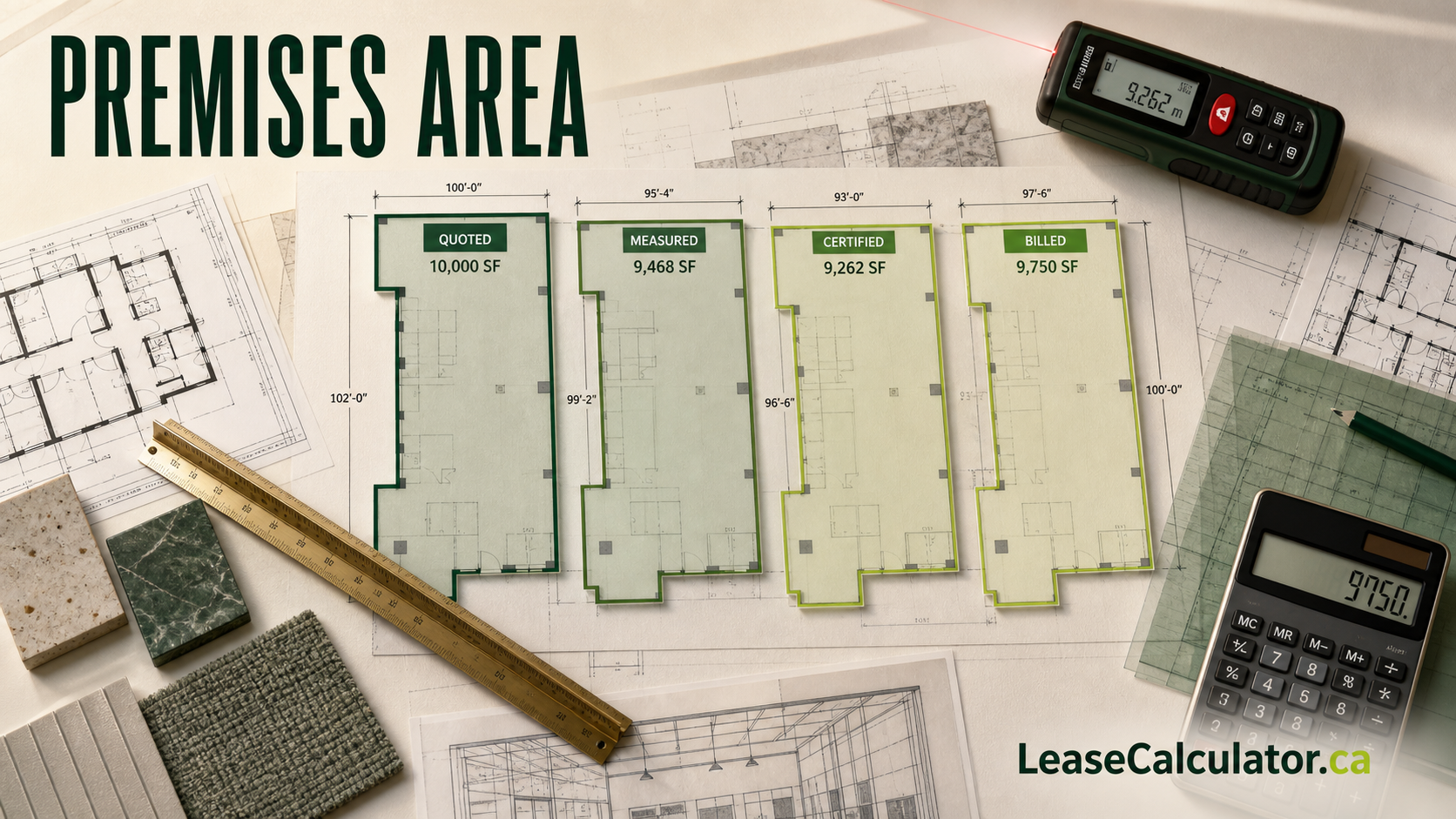
What this means for the deal
- Keep proposal, lease, amendment, measurement certificate, drawing and invoice areas as separate evidence records.
- Do not compare usable, rentable, gross-leasable, gross or exclusive-use area as though the labels mean the same thing.
- Record the exact instructed measurement standard and edition; do not assume a current standard automatically governs an older or specifically drafted lease.
- Price the area variance through every entered per-square-foot cost, with each line's actual start, end and escalation cadence.
- Treat tolerance, adjustment direction, timing, retroactivity, recovery allocation and notice as separate reviewed lease questions.
The rent rate is only half of a per-square-foot charge
A tenant may spend weeks negotiating a base-rent rate while the premises area receives one line in the proposal. Yet annual base rent is commonly the entered annual rate multiplied by an area defined elsewhere. Additional rent, taxes, operating-cost shares, utilities, improvement allowances, restoration budgets and brokerage commissions can also depend directly or indirectly on square footage.
A 2% area difference can therefore affect more than one invoice line and more than one year. It may also affect the tenant's operating plan: usable work area and rentable billing area answer different questions. Reconciliation should show both the physical and financial implications without suggesting that an arithmetic difference automatically changes the lease.
| Record | What it may represent | Control question |
|---|---|---|
| Marketing or proposal area | Pre-lease quoted area | Was the basis and source disclosed? |
| LOI area | Business term carried into drafting | Was it approximate, fixed or subject to measurement? |
| Executed lease area | Contractual premises or rent multiplier | Did an amendment later replace it? |
| Measurement certificate | Professional result under an instructed method | Which standard, edition, date and assumptions apply? |
| As-built drawing | Constructed geometry or design record | Is it a measurement deliverable or only a drawing? |
| Invoice or recovery schedule | Area currently used for billing | Does it match the operative source and allocation basis? |
Usable, rentable and gross-leasable are not synonyms
A usable or occupant-area figure generally describes space associated more directly with the occupier. A rentable figure may include allocations of shared areas under the selected method. Gross leasable area is a separate retail-oriented concept. Gross area can serve other analysis, construction, valuation or single-occupant purposes. The exact boundary and included components depend on the instructed standard and lease language.
Do not convert one basis into another by applying a market-average load factor. If both a supported usable and rentable figure are available, the ratio can be reported as an observed relationship for that file. It should not be used to certify the geometry or infer another building's area.
- Copy the area label exactly before translating it into a normalized field.
- Record whether the area is for the premises, floor, building, project or another allocation level.
- Keep vertical penetrations, common areas, amenities, service areas, mezzanines and exterior components inside the professional measurement analysis.
- If two records use different bases, stop the rent arithmetic until a qualified measurer reconciles them.
The property type and the lease instruction both matter
BOMA International currently publishes separate measurement standards for office, industrial, retail, mixed-use and gross-area purposes. Its official catalogue identifies BOMA 2024 for Office Buildings, BOMA 2025 for Industrial Buildings and BOMA 2025 for Retail Properties among the current editions. IPMS: All Buildings supplies a harmonized international framework across asset classes. Those publications do not decide which method governs a particular Canadian lease.
The operative lease may name a specific standard and edition, use its own defined area, preserve an older method, permit remeasurement or cap a load factor. An instruction prepared today may appropriately use a current standard; a historical lease review may need the edition actually incorporated. Record the instruction rather than silently upgrading it.
- Standard family and edition are two separate fields.
- A professional's certificate should identify the measured property, purpose, basis, standard, edition, date and preparer.
- BOMA states that it does not certify or endorse individuals, firms, devices or software for floor-area measurement; responsibility for the work stays with the preparing entity.
- The tool records standard evidence but never applies, reproduces or interprets a proprietary methodology.
Separate the measurement result from the adjustment right
A credible certificate can establish a professionally prepared measurement without establishing that rent changes. The lease may fix the area, permit a pre-commencement adjustment, allow later remeasurement, impose a tolerance, limit the direction of change, cap a load factor or require a particular process. Amendments, expansions, contractions and partial surrenders can replace the original premises record.
The team should independently control the right to measure, the selected standard, tolerance, adjustment direction, effective date, retroactive or prospective treatment, additional-rent allocation, notice requirements and dispute process. A spreadsheet should never infer those conclusions from the size of the variance.
| Control | Question | Evidence to preserve |
|---|---|---|
| Measurement right | Who may measure, and when? | Clause and amendments |
| Tolerance | What variance, if any, activates a review? | Exact wording and calculation basis |
| Adjustment | Can area-priced charges change, and in which direction? | Reviewed lease instruction |
| Effective date | When does an allowed change begin? | Reviewed date and implementation record |
| Retroactivity | Are past periods recalculated? | Legal and accounting instruction |
| Recovery share | Do numerator and denominator both change? | Lease allocation method and current schedule |
| Notice | Must anything be delivered, how and to whom? | Notice source, dispatch and receipt evidence |
Model every area-priced cost on its own schedule
Start with the area currently billed and the professionally supported or deliberately modelled target. Apply base rent, additional rent and any other entered per-square-foot charge separately. A base-rent step every two years should not force an annual increase onto the additional-rent estimate, and an additional-rent budget change should not alter fixed base rent.
For each line, record the opening annual rate per square foot, first applicable month, end month, change method, first change month and repeat interval. The output should show opening-year impact, each lease-year difference, full-term nominal difference and present value. Keep fixed charges and percentage rent outside the area model unless they genuinely vary with area and are deliberately entered on that basis.
- Negative target-minus-current cost means the selected target path is lower under the entered assumptions; it does not create a credit.
- Price both base rent and additional rent only if the reviewed lease says both use the affected area.
- If the building allocation denominator changes, model and review that change separately rather than changing only the tenant numerator.
- Keep GST/HST and accounting entries outside the headline unless the organization has deliberately chosen and documented a treatment.
Carry one reconciled result into every downstream record
Before a transaction, connect the supported area to requirements, proposal comparison, LOI and lease-draft QA. During delivery, connect it to the as-built drawings, certificate, possession record and commencement agreement. During administration, reconcile the rent schedule, invoice system, operating-cost allocation, security, insurance values, portfolio record and financial reporting where relevant.
Do not overwrite history. Preserve the prior area, new area, effective date, authority, professional work, reviewed instruction and every system updated. A clean amendment or commencement record should make it possible to explain why the billing area changed and when the change was implemented.
Frequently asked questions
Does a smaller measured area automatically reduce commercial rent?+
No. The measurement result and the contractual adjustment right are separate. Review the operative lease and amendments for the measurement basis, tolerance, direction, timing, notice and treatment of prior periods.
Which BOMA standard should a Canadian lease use?+
There is no automatic answer for every lease. The property type, intended purpose, professional instruction and negotiated lease wording matter. Record the exact standard and edition that actually govern the assignment or document.
What is the difference between usable and rentable area?+
They describe different measurement concepts. Rentable area can include allocations beyond the more directly occupied area under the selected method. Use the exact standard and certificate definitions; do not substitute a generic load factor.
Should additional rent change when premises area changes?+
Only after confirming the lease allocation mechanic. The tenant numerator, building denominator, excluded areas, gross-up and other allocation rules may all matter. A smaller premises figure alone does not establish the revised share.
Can LeaseCalculator.ca measure or certify the premises?+
No. The tool reconciles user-entered evidence and prices a scenario. A qualified measurement professional must perform and take responsibility for the actual measurement work.
Where the factual guidance comes from
These links support narrow factual points in this guide. They do not replace review of the proposal, executed lease or advice for the actual transaction.
BOMA International — Floor Measurement Standards ↗Official current standard catalogue for office, industrial, retail, mixed-use and gross-area measurement standards.BOMA International — Interpretations and Best Practices ↗Official guidance on measurement questions, rounding, professional responsibility and the limits of BOMA certification claims.IPMS Coalition — IPMS: All Buildings ↗Official harmonized international framework, published in 2023, for consistently describing measurement across building types.RICS — International Property Measurement Standards ↗Professional-standard context and the official IPMS All Buildings publication link.This guide is general educational information and financial-workflow support. It is not legal, tax, accounting, engineering, environmental, appraisal or brokerage advice. Verify source documents and obtain appropriate professional advice before acting.