What this means for the deal
- Keep today’s entered unit cost visible before applying any future change.
- Record the first cost-change month separately from the interval between later changes.
- Use exact cumulative index rows for irregular timing, updated budgets or externally sourced scenarios.
- Do not double-count escalation already included in a dated contractor quote or project budget.
- Treat public construction indexes as context unless they genuinely match the city, building type, trade mix and pricing basis being modelled.
Every future-cost scenario needs four answers
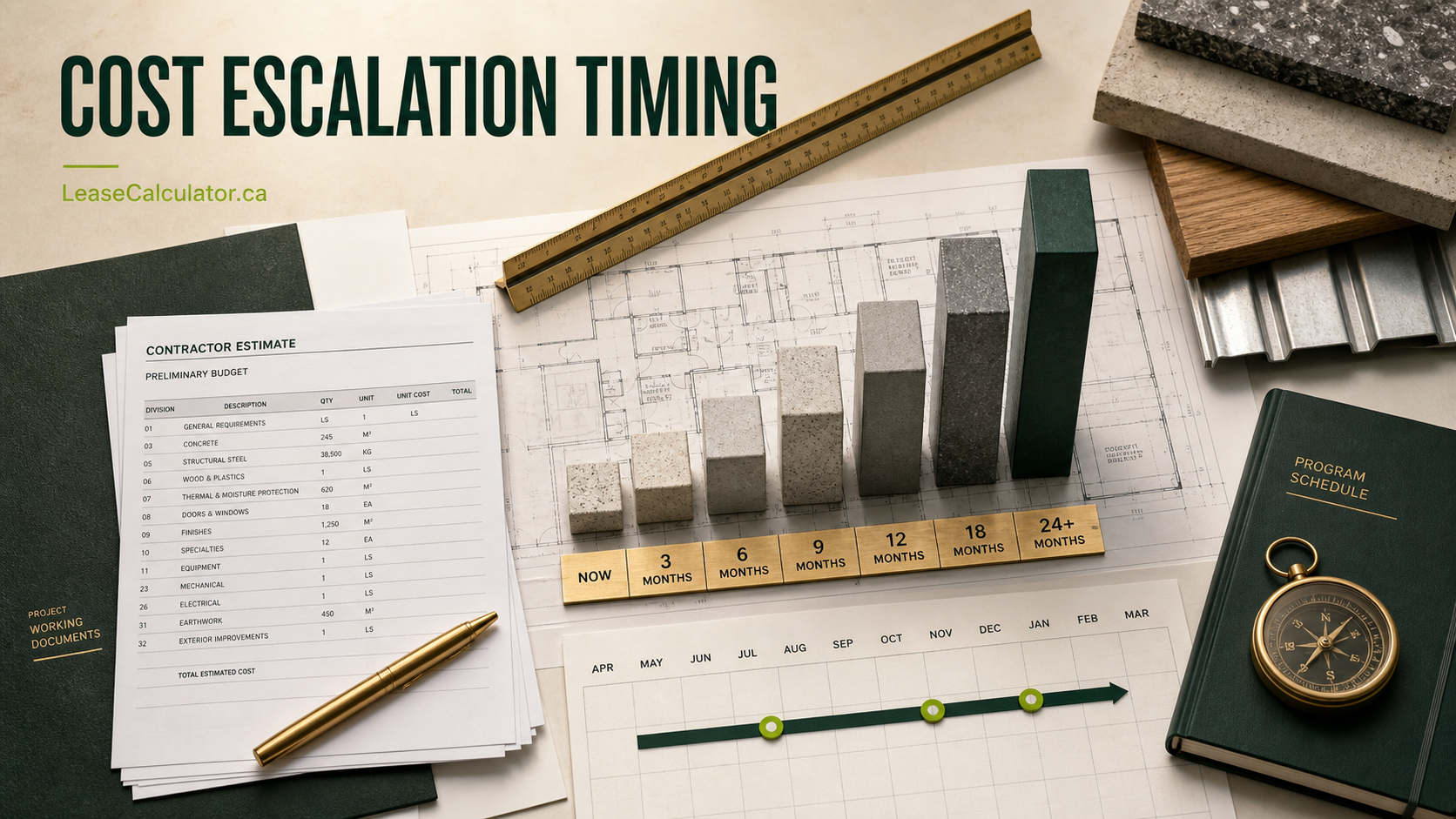
Start with the cost stated as of a known date, identify the analysis month that represents that date, place each scope item in the month the cost is expected to be committed or incurred, and select how the cost changes between those points. A percentage without its first effective month and repeat interval does not tell the calculator when to apply it.
The timing convention must be readable. In the Restoration & Make-Good workbench, analysis month 1 represents the analysis date. A first change in month 13 applies after twelve full months; month 25 follows two full years; month 61 follows five full years. Each scope row then looks up the schedule for its own work month instead of receiving one blanket annual uplift.
| Input | Plain-language question | Example |
|---|---|---|
| Base amount | What cost are we starting from? | $18/SF entered unit cost |
| Base timing | When is that amount stated in today’s model? | Analysis month 1 |
| Work timing | When is this scope item expected to happen? | Month 31 |
| Change method | How and when does the entered cost move? | 3% from month 13, then every 12 months |
Repeating percentage, dollar steps and exact indexes solve different problems
Use a repeating percentage when the scenario deliberately assumes that the then-current cost compounds at a regular interval. Use a repeating fixed-dollar change when the unit cost is expected to move by the same entered dollars at each interval. Use exact cumulative index rows when the changes are irregular, a budget has been refreshed, or the team wants to enter selected external-index scenarios without pretending they repeat forever.
An exact cumulative row is measured from the original entered cost. If month 13 is entered at 4% and month 31 at 9%, a $100 unit cost becomes $104 from month 13 and $109 from month 31. The 9% is not compounded again on the $104. This makes dated estimate updates and scenario steps easier to audit.
| Method | Best used when | Watch for |
|---|---|---|
| Repeating percentage | A regular compounding scenario is intentional | First month, interval and whether the source really compounds |
| Fixed dollars per unit | The scenario changes each entered unit cost by a known dollar step | Unit consistency across $/SF, each, linear foot and lump sum |
| Exact cumulative index | Changes are irregular or tied to dated budgets or index observations | Enter total change from the base, not the change since the prior row |
Use the month when pricing exposure actually matters
The right work month depends on what the model is trying to represent. A budget may be exposed when pricing is obtained, when the contract is awarded, when materials are purchased or when labour is performed. Those dates can differ. Choose one convention for the scenario, state it in the assumptions and use it consistently across comparable options.
Do not place every scope item in the handover month by default. Design and investigation may occur early; long-lead equipment may be committed before demolition; repair, cleaning and closeout may happen later. Item-level timing can materially change the total when a project crosses one or more entered cost-change points.
- Record the analysis date that anchors month 1.
- State whether the row uses quote date, award date, purchase date or expected performance date.
- Use separate rows when one package is likely to be committed in materially different periods.
- Update the work month when the project schedule changes; do not only revise the percentage.
A current quote, a future allowance and an index are not interchangeable
Ask what is already inside every entered price. A contractor quote may be firm only until a stated expiry date, may include expected material changes through procurement, or may exclude escalation entirely. A consultant budget may be expressed in current dollars, tender-date dollars or completion-date dollars. Applying another blanket uplift without reading the basis can count the same risk twice.
Keep the price-confidence state beside the number: rough allowance, preliminary budget, vendor quote, contracted amount or actual paid cost. Record the date, inclusions, exclusions, validity period, geography, trade scope and whether escalation is included. The calculator can apply the scenario entered; it cannot discover the pricing basis from a number alone.
- Current-dollar allowance: may need a separately entered timing scenario.
- Tender-date budget: may already include movement through the anticipated tender date.
- Firm quote: confirm expiry, substitutions, taxes, freight, duties and change conditions.
- Contracted or actual cost: do not re-escalate the committed or paid amount without a specific reason.
A public construction index is evidence of a measured series—not a project quote
Statistics Canada’s Building Construction Price Index measures changes over time in the prices contractors charge to construct selected representative residential and non-residential buildings. The program covers specified building types and census metropolitan areas and publishes quarterly series. That makes it useful context for observed price movement and scenario design.
It does not automatically price a particular tenant improvement, restoration package, building condition, procurement route, union or non-union labour mix, schedule constraint or contractor margin. If an index is used, record the exact table, geography, building type, division, reference periods and calculation. Enter the resulting cumulative scenario only after deciding that the series is relevant enough for the planning purpose.
Escalation, estimating range and contingency answer different questions
Low, expected and high unit costs describe uncertainty in the underlying scope and price. Cost escalation describes the entered change between the base date and the work month. Contingency reserves for remaining uncertainty in the expected project build-up. General conditions, professional fees, permits, taxes, delay and business downtime are separate layers. Combining them into one percentage makes negotiation and later reconciliation much harder.
The workbench applies the selected cost schedule to each row’s low, expected and high unit cost. It then shows expected scope at today’s entered costs and the cost-index timing impact separately before general conditions and contingency. This lets a reviewer challenge the base estimate, timing assumption or uncertainty reserve without dismantling one opaque total.
| Layer | Question answered | Typical evidence |
|---|---|---|
| Cost range | What might this defined scope cost now? | Estimate basis, quantities, quotes |
| Cost timing | How does the entered cost change before the work month? | Scenario, dated budget or relevant index |
| Contingency | What unresolved cost uncertainty remains? | Risk register and estimate maturity |
| Delay / downtime | What happens if handover or operations move? | Schedule and entered daily impacts |
Treat the schedule as a controlled assumption, not a permanent truth
Name the owner of the assumption, its source, the date last reviewed and the next decision point. Revisit it when design develops, landlord elections arrive, the tender date moves, a quote expires, procurement changes or actual costs replace estimates. Preserve the prior scenario when a decision was made from it instead of silently overwriting the record.
Before presenting the result, inspect every cost-change point and at least one scope row on each side of it. Confirm that the current-cost subtotal plus the displayed timing impact equals the timed scope subtotal. Export the evidence schedule when another reviewer must reproduce the calculation.
- Check month 1, every entered change month and the latest work month.
- Verify that exact index rows are cumulative from the same base.
- Confirm that project costs outside itemized scope have the intended treatment.
- Replace assumptions with project-specific pricing as the estimate matures.
Frequently asked questions
Does 3% annual cost escalation always begin in month 13?+
No. Month 13 is a common after-one-full-year model, but the scenario must state its own first change and repeat interval. A cost could remain flat for two or five years, change on irregular dates or use a one-time exact index row.
What does cumulative percentage mean in an exact index schedule?+
It is the total entered change from the original unit cost. A 10% row makes a $100 base cost $110 from that row’s month; it does not add another 10% to the prior custom row.
Should every restoration item use the lease-expiry month?+
Not automatically. Use the timing convention selected for the analysis and place each row in the month when its pricing exposure is expected to occur. Investigation, procurement, construction and closeout may happen at different times.
Can a Statistics Canada index replace a contractor quote?+
No. It is a measured series for specified representative buildings, geographies and components. It may inform a documented planning scenario but does not price the project’s exact scope, constraints, procurement or contractor terms.
How do I avoid counting escalation twice?+
Record the basis date and inclusions for every estimate or quote. If the entered amount already includes movement to tender, award or performance, do not apply the same period again. Separate current dollars, future dollars and firm quoted amounts.
Is cost escalation the same as contingency?+
No. Escalation changes the entered cost over time. Contingency reserves for remaining uncertainty. Estimate range, general conditions, fees, taxes, delay and downtime should also remain separate so each assumption can be reviewed.
Where the factual guidance comes from
These links support narrow factual points in this guide. They do not replace review of the proposal, executed lease or advice for the actual transaction.
Statistics Canada — Building Construction Price Index program ↗Official description, scope, frequency, target population, methodology and data-quality information for the Building Construction Price Index.Statistics Canada — Building construction price indexes by building and division ↗Official quarterly table 18-10-0289-01. Select the relevant geography, building type, division and reference periods before deriving a scenario.Statistics Canada — Building Construction Price Index visualization ↗Official visualization and coverage explanation for the residential and non-residential building construction price series.LeaseCalculator.ca — calculation methodology ↗Published calculation treatment for repeating percentage, fixed-dollar and exact cumulative restoration cost-index schedules.This guide is general educational information and financial-workflow support. It is not legal, tax, accounting, engineering, environmental, appraisal or brokerage advice. Verify source documents and obtain appropriate professional advice before acting.