What this means for the deal
- Record the first effective lease month separately from the interval between later changes.
- Do not translate every use of ‘annual’ into an automatic month-13 increase without checking the actual clause and dates.
- Keep base rent, additional rent, custom recurring charges and concessions on separate schedules.
- Use exact month-based rate steps for irregular deals, delayed increases, resets and partial periods.
- Preserve the source wording beside the normalized schedule so reviewers can challenge the interpretation.
Every repeating increase has three separate inputs
A complete escalation instruction answers three questions: how much does rent change, when does the first change take effect, and how many months pass before it changes again? ‘Three percent annually’ supplies an amount and a rough cadence, but it may not identify whether the first increase occurs on the commencement anniversary, a fixed calendar date, the beginning of a stated lease year or another date defined elsewhere in the documents.
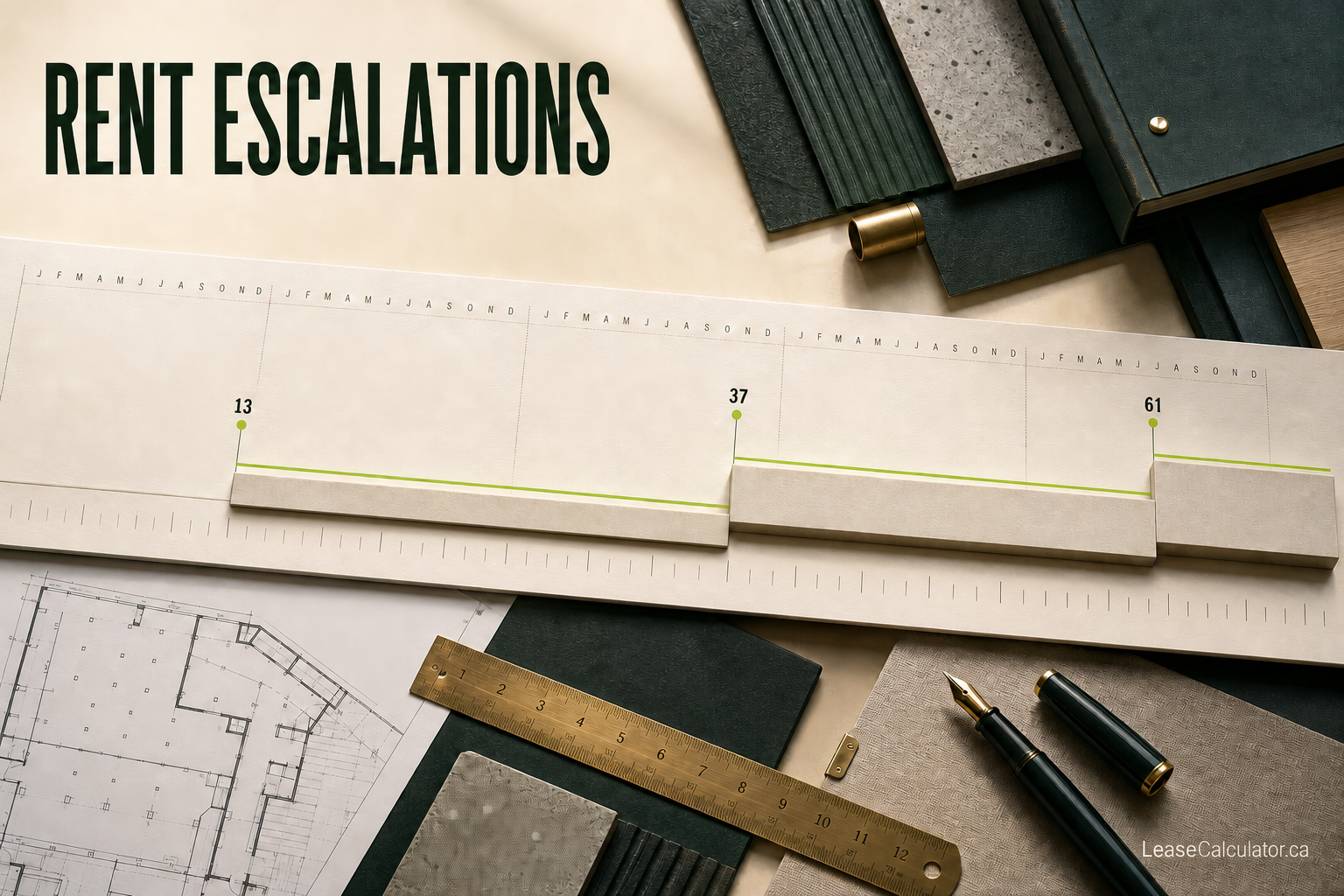
Translate the clause into lease months only after reconciling commencement, rent commencement, partial periods, defined lease years and amendments. Lease month 1 is the first month in the model. An anniversary increase usually begins in month 13, not month 12. A five-year flat period followed by a five-year increase usually begins in month 61. Those are modelling examples, not interpretations of any particular lease.
| Business wording | Normalized inputs | Question to resolve |
|---|---|---|
| 3% on each anniversary | 3%; first change month 13; repeat every 12 months | Which date is the relevant anniversary? |
| $1.00/SF every two years | $1.00/SF; first change month 25; repeat every 24 months | Is the increase cumulative from the then-current rate? |
| Flat for five years, then 8% | 8%; first change month 61; confirm whether it repeats | Is month 61 a one-time step or the start of a new cadence? |
| Years 1–2 $18; years 3–4 $20; year 5 $22 | Exact rates from months 1, 25 and 49 | How does any partial final year work? |
| Increase each January 1 | Exact calendar-effective changes converted to lease months | How is the first partial calendar period treated? |
Percentage, fixed-dollar and stated-rate schedules are not interchangeable
A percentage increase normally compounds on the then-current rate. A fixed-dollar step adds the stated annual dollars per square foot at each scheduled change. A stated-rate schedule replaces the rate with the amount written for that period. These methods can produce materially different totals even when their first increase looks similar.
Use a repeating method only when the clause actually repeats in a consistent way. Use one rate for each lease year when the proposal gives a complete year-by-year table. Use exact lease-month steps when changes are irregular, delayed, tied to amendments, or expressed through calendar dates. Never force an irregular schedule into an average annual percentage merely to make the input easier.
- Confirm whether a percentage is applied to the opening rate or the then-current rate.
- Confirm whether a dollar step is quoted per rentable square foot per year or as a monthly amount.
- Retain zero-change periods instead of deleting them from the evidence trail.
- Do not model a future fair-market-rent reset as a known escalation unless an actual scenario rate has been deliberately entered.
Base rent timing does not automatically control every other charge
Additional rent, operating-cost estimates, property-tax recoveries, parking, storage, utilities and service charges may have different adjustment dates. A base-rent anniversary does not prove that recoveries change on the same day. Model the entered additional-rent estimate with its own first change and interval, and use separate custom items when the proposal identifies distinct timing or treatment.
The same discipline applies to included value. Parking or equipment described as included may have economic value for comparison, but it is not automatically a cash incentive. A recurring charge can begin after occupancy, end before expiry, or grow every six months. Keep its amount, basis, start month, end month and growth interval visible.
- Base rent: percentage, dollar or exact stated-rate schedule.
- Additional rent: entered estimate with its own change timing and reconciliation boundary.
- Other recurring items: monthly, annual or $/SF/year with explicit start and end months.
- Included items: replacement-value comparison credits, not reductions to contractual rent.
- One-time costs: place them in the month the cash is expected to move.
Free rent needs a start month and a cost scope
Free rent is often summarized as a number of months, but the cash result depends on where those months occur and what charges are waived. A deferred concession beginning in month 13 has a different present value from the same concession at commencement. Base-only abatement is different from a period that also waives additional rent or other recurring charges.
Record the concession start month, consecutive length and scope from the source. Keep tenant-improvement allowance, landlord work and other cash contributions separate; they may have eligibility, draw and evidence conditions that cannot be represented by free-rent months.
| Control | Why it changes the result | Evidence to retain |
|---|---|---|
| Start month | Changes nominal timing and present value | Proposal clause and date |
| Length | Determines the number of abated payments | Exact consecutive or selected periods |
| Scope | Determines which cost layers remain payable | Base, additional and other-charge wording |
| Conditions | May affect whether value is actually received | Possession, opening, default or draw conditions |
Inspect the change points before trusting the total
A monthly model should expose every month where the base rate, additional-rent rate or concession status changes. Compare those milestones with the proposal before relying on total obligation, effective rent or present value. This catches common off-by-one errors, silent annual assumptions and concessions applied to the wrong period.
For proposal comparison, hold the area basis, decision horizon, discount rate and cost classification consistent. Preserve the original proposal and each counter separately. If the rent timing is ambiguous, model a clearly labelled scenario range and carry the question into the negotiation or diligence record instead of disguising uncertainty as precision.
- Check month 1, every rent-change month, every concession start and end, and the final month.
- Compare scheduled contract rent separately from cost after incentives and included value.
- Export the monthly evidence schedule when another reviewer needs to reproduce the result.
- Re-run the complete model when a counteroffer changes timing, not only when it changes the percentage.
Frequently asked questions
Does a 3% annual escalation always begin in month 13?+
No. Month 13 is a common anniversary model, but the executed wording and defined dates control. Confirm the first effective date, any partial period and the repeat cadence before entering the schedule.
What is the difference between a percentage increase and a dollar step?+
A percentage usually compounds from the then-current rate. A dollar step adds a stated annual amount per square foot. A stated-rate schedule instead replaces the rate with the exact amount entered for the period.
How should a rent increase every five years be entered?+
If the first increase begins at the start of year six, enter lease month 61 as the first change and 60 months as the repeat interval only if the increase actually repeats every five years. Use an exact one-time rate step if it does not repeat.
Should operating costs use the same escalation as base rent?+
Not automatically. Additional rent and operating-cost estimates may change on a different schedule and remain subject to actual budgets and reconciliations. Enter their timing separately and preserve the underlying lease treatment.
How is deferred free rent modelled?+
Enter the lease month where the concession starts, its consecutive length and the charges it actually waives. Do not assume every free-rent period begins at commencement or includes additional rent.
Where the factual guidance comes from
These links support narrow factual points in this guide. They do not replace review of the proposal, executed lease or advice for the actual transaction.
LeaseCalculator.ca — calculation methodology ↗Published definitions for monthly rent schedules, concessions, custom costs, effective rent and present value.LeaseCalculator.ca — Canadian leasing glossary ↗Plain-language definitions for base rent, additional rent, escalation, inducements and related lease terms.Canada Revenue Agency — Commercial Real Property: Sales and Rentals ↗Official GST/HST memorandum covering commercial rent, additional rent and lease inducements; included for the guide's tax boundary.This guide is general educational information and financial-workflow support. It is not legal, tax, accounting, engineering, environmental, appraisal or brokerage advice. Verify source documents and obtain appropriate professional advice before acting.