What this means for the deal
- Treat permitted use, prohibited use, exclusivity, radius restrictions, continuous operation and co-tenancy as separate controls.
- Translate the tenant’s real operating model into products, services, channels, ancillary activities and future growth before testing the wording.
- Measure occupancy only on the lease-defined numerator, denominator, area, operating test, exclusions and date.
- Record every named retailer, replacement test and competing-use observation with a dated source and verification state.
- Route the scope, duration, territory and market effect of competitor property controls for current Canadian competition-law review.
- Do not model alternative rent or termination as available merely because an entered percentage is below a threshold.
Six retail controls can interact without meaning the same thing
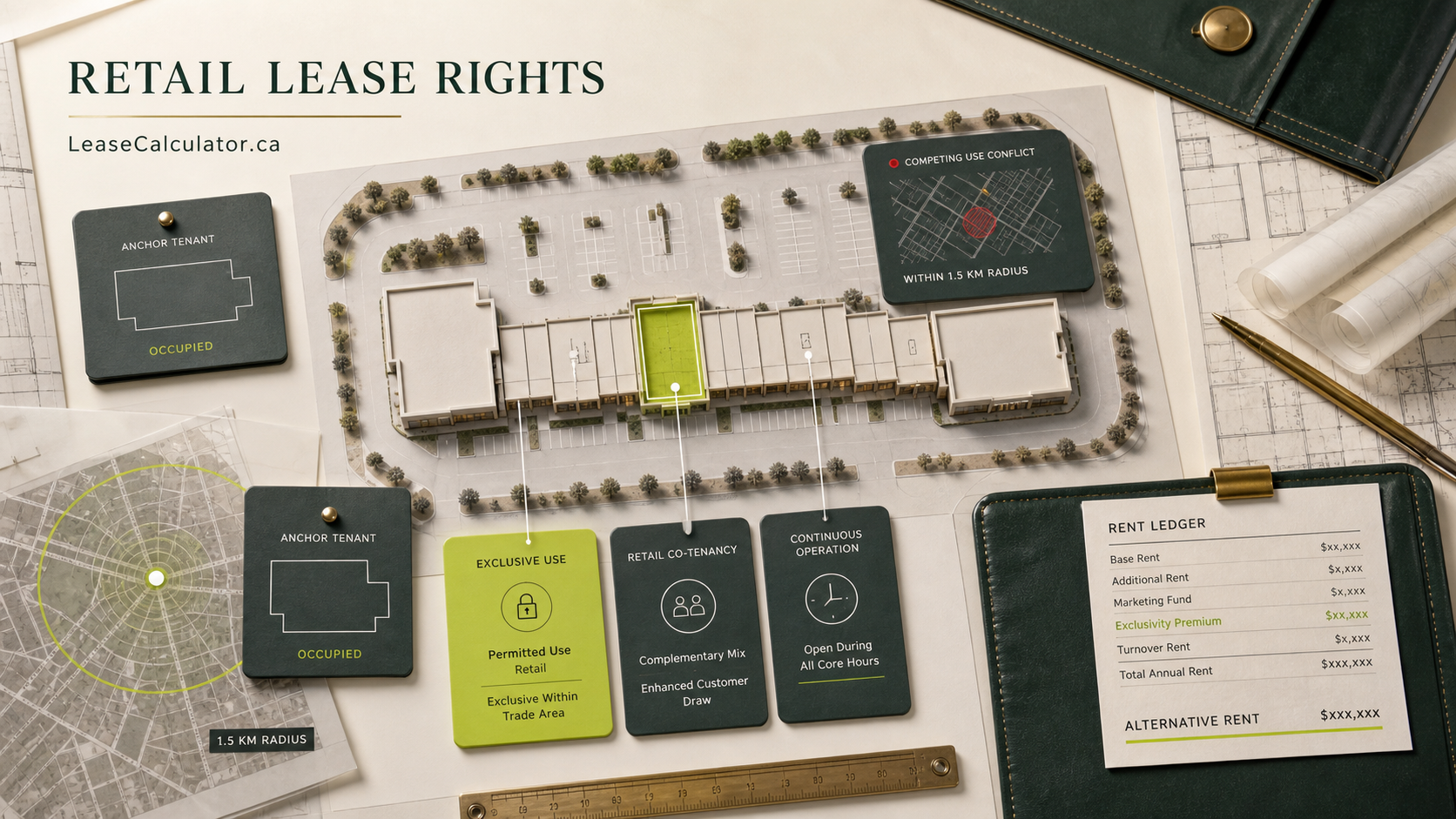
A permitted-use provision describes what the tenant may do in the premises. Prohibited-use wording can restrict particular activities across the property or within the premises. An exclusivity provision can limit what the landlord permits elsewhere. A radius restriction can limit the tenant or related parties outside the property. A continuous-operation covenant addresses whether and how the tenant must remain open. A co-tenancy provision can connect opening, ongoing operation or rent treatment to other retailers or defined occupancy.
Create a separate record for each control, then map their interactions. A tenant may have a broad permitted use but narrow exclusive protection. A use may be permitted by the landlord yet still require zoning, building, health, liquor, cannabis, signage or another public approval. An exclusive may protect only a primary-use category while allowing incidental sales. A co-tenancy remedy may apply while additional rent, percentage rent, operating covenants or reporting duties continue.
| Control | Business question | Evidence to preserve |
|---|---|---|
| Permitted use | What may this tenant sell, provide or operate? | Lease wording and complete operating brief |
| Prohibited use | What may not occur in the premises or property? | Defined restrictions, property rules and approvals |
| Exclusivity | What competing activity may the landlord restrict? | Protected category, territory, exceptions and existing rights |
| Radius | Where may this tenant or affiliate not operate? | Map, distance method, channels, exceptions and proposed location |
| Continuous operation | Must the store remain open and active? | Hours, closure exceptions, default and recapture wording |
| Co-tenancy | Who or how much of the centre must be open? | Named retailers, occupancy calculation, duration and remedy |
A useful permitted use begins with operations, not a category label
Write the current and reasonably planned operating model before judging the clause. Identify primary products and services, ancillary offerings, concessions, food or beverage, preparation, pickup, delivery, returns, repairs, classes, events, subscriptions, online fulfillment, ship-from-store, storage, outdoor activity and future channels. Record equipment, hours, noise, odour, waste, loading, parking, power, ventilation, licensing and customer-flow requirements where they affect the use.
Compare the operating brief with the exact verbs, defined terms and qualifiers in the lease. Wording limited to one named trade name, one narrow product category or a single current concept may constrain later rebranding, merchandising or transfer. Broad wording can create property-management or exclusivity risk for the landlord. The business position should identify intended flexibility and controls; counsel should draft and interpret the legal result.
- Separate the legal tenant name from the brand or banner used at the premises.
- Identify primary activity and ancillary activity instead of relying on one industry label.
- Map omnichannel ordering, fulfillment, pickup, delivery and returns separately.
- Record future product lines, services, automation, franchise or concession plans that are reasonably foreseeable.
- Keep landlord consent separate from municipal, regulatory and professional approvals.
An exclusive is only as usable as its category, territory and exceptions
Capture the protected activity using the lease’s complete defined terms. Determine whether the test concerns a retailer’s primary business, a product category, a percentage of floor area, a percentage of sales, a department, a service or any sale at all. Identify whether the protection applies to the current property, future phases, outparcels, adjacent lands, properties under common control or only a schedule-shown area.
Inventory every carve-out: existing tenants, renewals, expansions, assignments, transfers, department stores, grocery stores, pharmacies, restaurants, temporary tenants, kiosks, concessions, seasonal sales, incidental sales, de minimis thresholds and landlord dispositions. A summary spreadsheet should link each exception back to the executed source. Do not promise a new use until all existing protections and amendments are reconciled.
Competitor property controls require current Canadian review
The Competition Bureau describes competitor property controls as restrictions on the use of commercial real estate and identifies exclusivity clauses and restrictive covenants as two forms. Its June 2025 enforcement guidance states that these controls are common in retail settings and can raise serious competition concerns, while recognizing that limited circumstances may support a pro-competitive justification. The Bureau’s position and the Competition Act can evolve; the published guidance is context, not approval of a particular clause.
For a proposed protection, preserve the commercial rationale, investment or entry concern, protected activity, duration, geography, market facts, affected competitors, exceptions and less restrictive alternatives. Route the complete facts and wording to qualified competition and leasing counsel. The workbench does not assess market power, purpose, competitive effects, statutory tests, defences or enforcement risk.
- Do not assume that a widely used leasing practice is automatically compliant.
- Do not describe a Competition Bureau investigation as a finding of wrongdoing.
- Review lease exclusivity and land-title restrictive covenants as distinct instruments.
- Revisit old protections when renewing, amending, acquiring, disposing or adding phases.
- Preserve the current official guidance and legal review date in the decision file.
Opening and ongoing co-tenancy can use different tests and consequences
Opening co-tenancy commonly addresses conditions at or before the tenant’s required opening. Ongoing co-tenancy addresses conditions during the term. The two provisions may name different retailers, use different occupancy thresholds, measure different areas, allow different replacement tenants and lead to different rent or termination choices. Keep them as separate records even when a proposal groups them under one heading.
For each provision, capture the condition, required duration, notice, evidence, cure, alternative-rent period, restoration of full rent, termination window and interaction with continuous operation. Confirm whether the tenant must itself be open to use a remedy and whether late opening, temporary closure, renovation, casualty, condemnation, force majeure, seasonality, transfer or default changes eligibility.
| Field | Questions | Why it changes the result |
|---|---|---|
| Named retailer | Exact entity, banner, premises and minimum area? | A brand, affiliate or replacement may not satisfy the same test |
| Replacement | Same category, size, sales, draw, number of stores or landlord approval? | A replacement label alone may be insufficient |
| Occupancy | Open, leased, occupied, paying, retail or gross leasable area? | Different numerators produce different percentages |
| Duration | Immediate, continuous, average or sustained for a period? | A short closure may be treated differently |
| Cure | What may be cured, by whom and with which evidence? | The remedy may be delayed or end after cure |
| Election | Alternative rent, termination or another entered choice? | Rights may expire if the process is not followed |
An occupancy percentage is meaningful only with its full basis
Document the numerator and denominator. Determine whether the calculation uses leased area, occupied area, open-and-operating area, gross leasable area, retail area or another defined measure. Record the included property, phases, outparcels, anchors, non-retail uses, temporary tenants, pop-ups, storage, office, kiosks, common areas and premises under construction. Use one consistent area source and date.
Build a tenant-by-tenant schedule when the result matters. For each space, preserve area, use, lease status, possession, opening status, temporary closure, source and verification. Reconcile the total to the approved property area record. A leasing report, rent roll, directory and site visit can answer different questions and should not be silently substituted for one another.
Preserve who, what, where, when and how you know
For a named retailer, record the exact required name or class, minimum premises area, permitted replacement test, current location, operating status, observation date and source. A store shown on a directory may not be open; a dark store may still hold a lease; a replacement may be open without meeting the contractual test. Keep the factual state separate from the reviewed condition status.
For a possible exclusivity conflict, record the observed business, products or services, floor area or prominence if relevant, location, date, photographs or directory source, proposal materials and reviewer. Describe observable facts before comparing them with the protected category and carve-outs. Do not publish an accusation or label a breach before the source, wording and process are reviewed.
Move from observation to review to authorized action
Create a dated issue record when a potential conflict, anchor closure or occupancy gap appears. Identify the lease source, factual evidence, responsible business owner and required legal, accounting, finance or property-management review. Preserve communications and notices in the approved repository. A dashboard status is not notice, consent, waiver, cure or election.
If a party is considering alternative rent, closure, termination, enforcement or a new lease commitment, prepare a one-page brief that separates confirmed facts, disputed facts, clause wording, entered economic scenarios, procedural requirements and authority. Keep the most conservative operational assumption visible until the decision is approved. Export a new version when facts or documents change instead of overwriting the earlier record.
Frequently asked questions
What is a permitted-use clause in a retail lease?+
It describes the activities the tenant may conduct in the premises, often subject to restrictions, approvals and other lease terms. The exact scope depends on the complete wording and facts; a broad business label is not a reliable substitute.
What is an exclusive-use clause?+
It is a lease provision that can restrict the landlord from permitting defined competing activity within an entered territory, subject to scope, thresholds, exceptions and remedies. It can also require competition-law review.
What is retail co-tenancy?+
It is a lease structure that can connect opening, ongoing obligations or rent treatment to named retailers, replacement tenants, a defined occupancy threshold or another condition. The exact condition and consequence come from the lease.
Does an anchor closing automatically reduce the tenant’s rent?+
No. The closure is a fact. Eligibility may depend on the exact named-retailer test, replacement wording, occupancy threshold, duration, tenant compliance, notice, cure, election and other conditions in the complete documents.
Can the tool determine whether an exclusivity was breached?+
No. It records the entered protection, carve-outs, territory and observations and identifies missing evidence. Legal interpretation, competition-law analysis, breach, remedy and enforcement require qualified review.
What evidence should support a co-tenancy review?+
Typically the complete lease and amendments, current property area source, tenant roster or rent roll, store-opening and closure evidence, site observations, directory records, replacement-tenant facts, calculation workpaper, notices and review record, subject to privacy and document-control requirements.
Where the factual guidance comes from
These links support narrow factual points in this guide. They do not replace review of the proposal, executed lease or advice for the actual transaction.
Competition Bureau Canada — Competitor property controls and the Competition Act ↗Official June 2025 enforcement guidance describing exclusivity clauses and restrictive covenants and the Bureau’s approach to competitor property controls. It is not approval or legal advice for a particular lease.Justice Laws Website — Competition Act ↗Official consolidated federal legislation. Use the current version and qualified competition-law advice; the platform does not apply statutory tests to an entered lease control.Competition Bureau Canada — Retail Grocery Market Study ↗Official market-study material explaining property controls in the grocery context. Grocery examples illustrate competition concerns but do not establish the result for another sector or agreement.Ontario — Renting commercial property in Ontario ↗Official provincial overview emphasizing the importance of the signed commercial lease and appropriate legal advice. It does not define a national use, exclusivity or co-tenancy rule.British Columbia — Commercial Tenancy Act ↗Official current provincial legislation. The statute and common law must be considered with the complete agreement; the platform does not determine their application.Québec — Civil Code of Québec ↗Official Civil Code source. Québec civil-law analysis is distinct from common-law provinces and requires province-specific professional review.This guide is general educational information and financial-workflow support. It is not legal, tax, accounting, engineering, environmental, appraisal or brokerage advice. Verify source documents and obtain appropriate professional advice before acting.