What this means for the deal
- Keep the assessment notice, official tax bill and landlord recovery statement as three separate source records.
- Rebuild every rate, levy, adjustment, tenant share, cap, fee, sales-tax amount and credit rather than checking only the total.
- Use the complete executed lease to determine inclusions, exclusions, allocation and refund mechanics.
- Treat complaint deadlines, filing authority and tax-payment obligations as jurisdiction-specific questions.
- Follow any revised assessment through the municipal tax account and into the correct lease year before modelling a tenant credit.
- Preserve a source, owner, status and as-of date for every number used in a reconciliation.
Assessment, tax and tenant recovery answer different questions
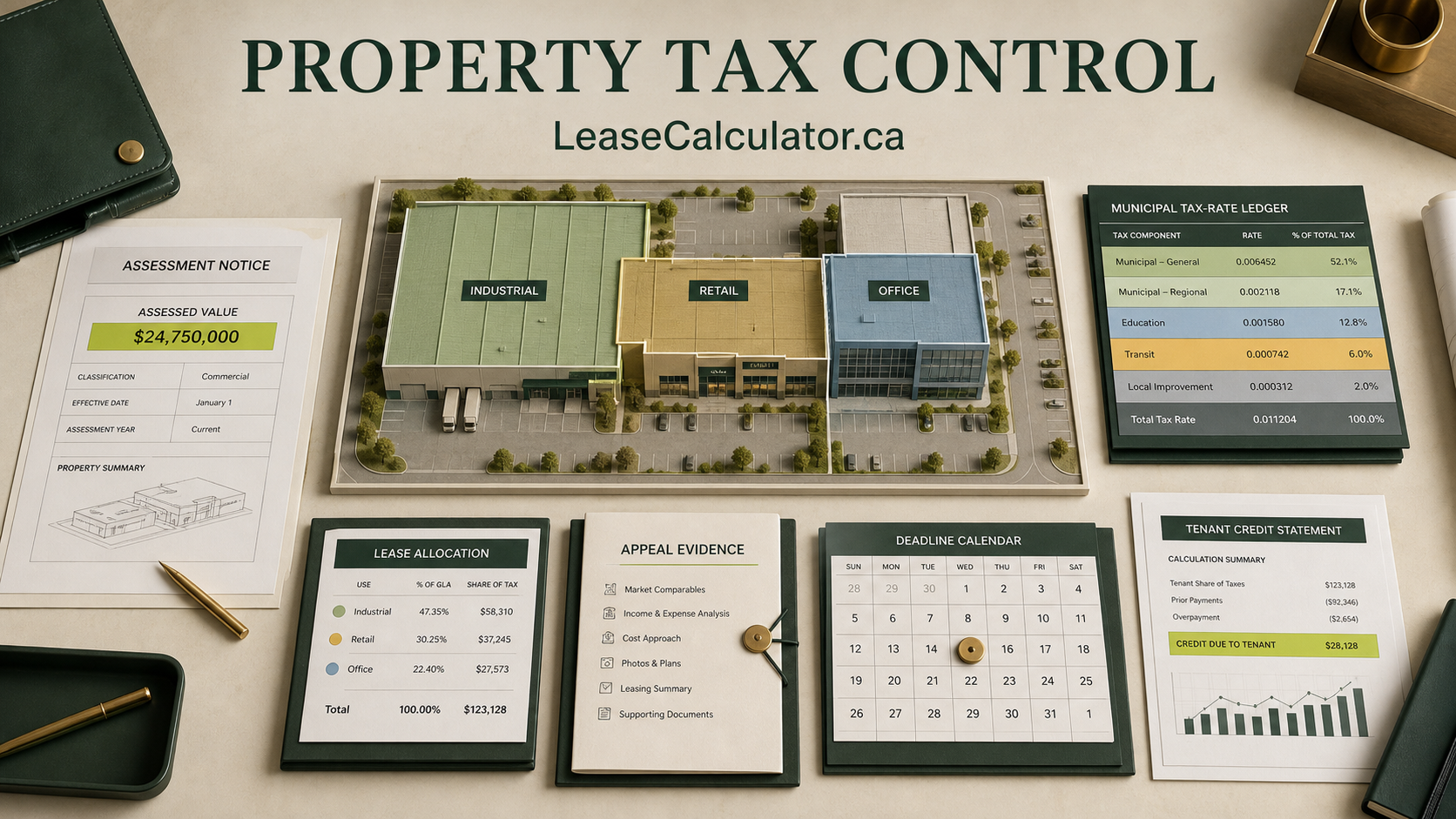
An assessment notice records the authority's entered value, classification, property facts and key dates for a taxation year. A municipal tax bill applies the applicable rates, levies and adjustments to the taxable bases. A landlord statement applies the lease definition and allocation rules to determine what the landlord says one tenant owes. Similar numbers can appear in all three records, but none proves the correctness of the others.
Build a three-way bridge. First tie the assessment record to the correct roll, class, valuation date, physical-condition date and notice. Then tie the municipal bill to that roll and its individual tax components. Finally tie each recoverable component to a signed lease source, tenant allocation, cap, fee, GST/HST treatment and cash record. Mark every missing or disputed bridge explicitly.
| Record | Question it answers | Typical control |
|---|---|---|
| Assessment notice / roll | What value, class and facts did the authority enter? | Roll, year, dates, class, value and source status |
| Municipal tax bill | What rates, levies and adjustments were charged? | Component-by-component bill rebuild |
| Lease recovery statement | What amount is allocated to this tenant? | Definition, share, cap, fee, tax and credit tie-out |
The headline value is only the beginning of the review
Confirm the exact roll or account, taxation year, notice type, assessed owner, property address and legal description where relevant, tax class and subclass, actual use, valuation date, condition date, land and improvement components, machinery or equipment treatment, exemptions and any supplementary, omitted, amended or revised notice. The terminology and legal significance vary across Canada, so keep the authority's words rather than translating them into assumed national labels.
Compare the authority record with the property that actually existed at the relevant dates: area, use, occupancy, construction, age, condition, renovations, vacancy, income characteristics and zoning or permitted-use facts. A discrepancy is a review item, not automatic proof that the assessment is wrong. Preserve the source and engage qualified valuation, assessment and legal reviewers where appropriate.
- Is this the correct roll and taxation year?
- Does the property class match the entered use and authority record?
- Do land, improvements and other components add to the stated total?
- Are supplementary or omitted notices linked to the right period?
- Is the complaint or first-level review deadline copied from a current official source?
One annual total can contain charges with different treatment
List municipal, education, regional, business-improvement-area, local-improvement, supplementary or omitted, machinery and equipment, special levy, credit, penalty and interest items separately. Use the actual bill amount when available. If reproducing a calculation, record whether the entered rate is per $1,000 of assessment, a percentage of a taxable base, a flat levy or another official method. Never infer an official rate or class from a neighbouring property.
Tie opening balance, instalments, adjustments, refunds, interest and closing balance to the municipal account. An assessment reduction does not necessarily produce an immediate cash refund; the municipality may issue a revised bill, apply a credit, offset arrears or change a later instalment. Keep assessment-result date, tax-adjustment date and cash date separate.
A tax expense is not automatically a tenant charge
Read the definitions of taxes, operating costs, additional rent, proportionate share, rentable area, building, project and fiscal year together with the tax, audit, appeal, payment, default, gross-up, management-fee and reconciliation provisions. Check every amendment, expansion, contraction, surrender, assignment and commencement document. Identify exclusions such as landlord income or capital taxes, penalties caused by late payment, development charges, taxes attributable to other property, or costs not permitted by the negotiated wording.
Map appeal control and economics separately. Who decides whether to challenge an assessment? Must either party notify or cooperate with the other? Who supplies information, hires the consultant, approves settlement and pays fees? If the review succeeds, which years and tenants receive the benefit, when must a credit be given, may costs be deducted, and what happens after lease expiry? Do not fill silence with a preferred business answer.
| Issue | Capture | Common hidden problem |
|---|---|---|
| Definition | Included and excluded tax items | Bill label treated as lease authority |
| Allocation | Numerator, denominator, pools and direct charges | Area share assumed without lease support |
| Cap | Eligible amount, base, cadence and exceptions | Cap applied to the whole bill |
| Fee | Rate, base and excluded rows | Administration fee added to ineligible tax |
| Refund | Year, share, costs, timing and interest | Property refund not traced to tenant credit |
The denominator can matter more than the tax rate
An area fraction may use premises rentable area divided by building rentable area, but the lease may instead use a project denominator, tax lot, floor, phase, occupancy category, direct attribution or landlord-determined equitable allocation. Mixed-use buildings can require separate office, retail, parking or other tax pools. Vacant area, common areas, expansion space, storage, mezzanines, assessment subclasses and mid-year occupancy changes can alter the result.
Reconcile the numerator and denominator to source documents and the correct period. If the lease uses an entered proportionate share, preserve the executed source and any adjustment mechanism. If the landlord directly allocates a charge, record the reason and evidence. Avoid double recovery by checking whether a tenant-specific tax is already paid directly or included elsewhere.
- Use like-for-like areas and the lease-defined measurement standard.
- Separate recurring share allocation from direct tenant attribution.
- Apply caps and administration fees only to components supported by the lease.
- Document any mixed-use pool, vacant-space treatment or mid-year proration.
- Reconcile all tenant shares and landlord-retained amounts to the recoverable pool where the lease requires it.
Estimates, reconciliation and review credits need one timeline
For each lease year, record monthly estimates, the landlord's annual target, payments, prior credits, reconciliation adjustment, issue date, due date and any disputed amount. Then add assessment-review fees, revised tax bills, refunds and post-review credits as distinct events. A positive credit and an additional charge should both be traceable to the assessment year, tax adjustment and lease rule that produced them.
Review GST/HST separately. Current CRA guidance generally treats a tenant reimbursement of the landlord's property tax as part of commercial rent and gives it the same GST/HST treatment, while a tenant's direct liability to the municipality can differ. Confirm the actual legal liability, invoicing arrangement, registration status and current tax advice rather than applying a generic percentage mechanically.
A complete review ends at the bank—not at the assessment decision
Tie the annual municipal tax account to the property ledger, the recoverable tax pool, each tenant allocation, invoices, receipts, credits and closing balance. Reconcile current-year, prior-year and supplementary items separately. If a review covers multiple years, build one schedule per year and preserve the tenant roster and lease status that applied to each period.
Create an exception queue for missing notices, unverified rates, class disputes, unsupported lease inclusions, denominator mismatches, cap conflicts, fee authority, sales-tax treatment, missed or open deadlines, unknown filing authority, unreconciled municipal credits and tenant balances. Give each issue an owner, source required, due date and disposition.
Use one file to preserve facts without pretending to replace expertise
The Property Tax Control workspace connects the property and share, lease rules, assessment years, tax components, complaint or appeal record, billing schedule, evidence register and review queue. Start with the Calgary industrial, Toronto mixed-use retail or Vancouver office example, then replace every illustrative number, date and source with the actual file.
Export the annual comparison, monthly cash schedule, review brief and portable JSON file. Store approved evidence and outputs in the organization's controlled system. Reopen the file whenever a new notice, tax bill, rate, lease amendment, filing, decision, refund, tenant statement, payment or credit changes the answer.
Frequently asked questions
Is the assessed value the amount of property tax owed?+
No. The assessment is a value or taxable base entered under the applicable system. The municipality applies current rates, levies and adjustments to create the tax bill.
If the landlord paid a property tax, must the tenant reimburse it?+
Not automatically. The complete executed lease and facts determine whether the item is included, excluded, allocated, capped, fee-bearing or credited.
Is tenant share always premises area divided by building area?+
No. The lease may use an entered share, project or tax-pool denominator, direct allocation, mixed-use method or another negotiated rule.
Does filing an assessment complaint stop the tax-payment deadline?+
Do not assume so. Confirm the current notice, municipal instructions and applicable law. For example, Calgary's official complaint form states that taxes still must be paid by the due date while a complaint is underway.
Should a tenant receive a credit after an assessment reduction?+
Trace the reduction into the municipal tax account, then apply the actual lease refund, cost, timing and allocation provisions. A modelled credit is not proof of entitlement or payment.
Is GST/HST charged on a landlord's property-tax recovery?+
CRA guidance generally treats a tenant reimbursement of the landlord's property tax as part of rent, while direct tenant liability to the municipality can differ. Obtain current advice for the actual arrangement.
Where the factual guidance comes from
These links support narrow factual points in this guide. They do not replace review of the proposal, executed lease or advice for the actual transaction.
Alberta — Property assessment ↗Official overview explaining annual assessment and its role in distributing the municipal property-tax burden.Calgary — Property assessment complaints ↗Official Calgary instructions distinguishing assessment complaints from tax appeals and directing owners to the exact notice deadline and fee.Toronto — Property assessment and appeals ↗Official municipal overview of MPAC assessment, commercial review routes and tax adjustments; verify the current year and file.BC Assessment — Appeals ↗Official first- and second-level assessment appeal overview and current deadline information.Canada Revenue Agency — GST/HST special cases ↗Official CRA guidance addressing commercial rent and tenant reimbursement of landlord property taxes; confirm current application to the actual arrangement.This guide is general educational information and financial-workflow support. It is not legal, tax, accounting, engineering, environmental, appraisal or brokerage advice. Verify source documents and obtain appropriate professional advice before acting.