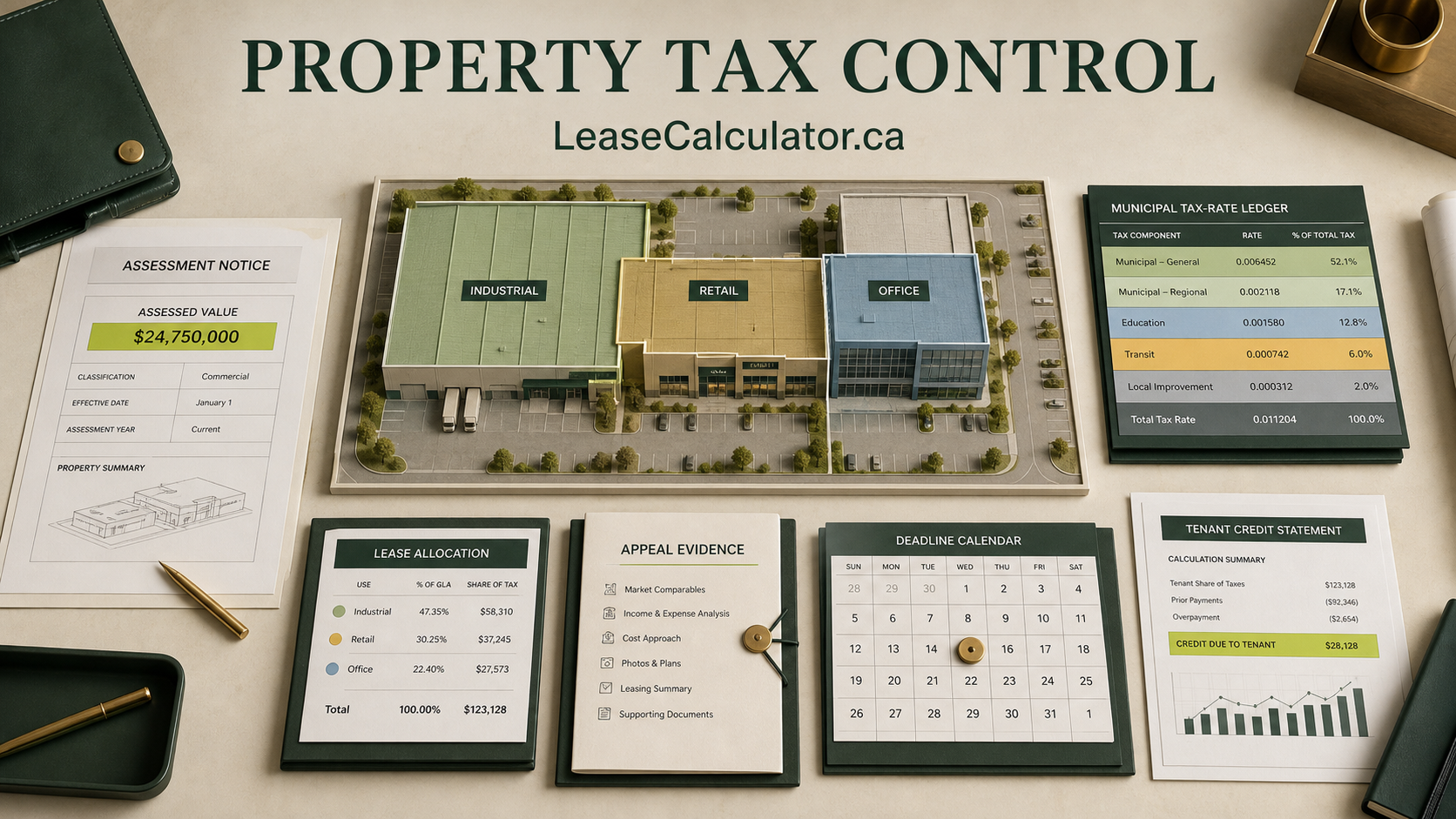
What this means for the deal
- Confirm the responsible assessment authority, current notice, exact route and deadline before doing economic modelling.
- Identify the legally permitted filer, any required authorization and the lease party that controls or participates in the process.
- State specific review issues and requested corrections instead of filing a general belief that the value is too high.
- Build evidence around the jurisdiction's test and procedure; do not treat the workspace as valuation or appraisal evidence.
- Continue controlling property-tax payment and lease billing while the complaint proceeds unless current authority supports a different treatment.
- Trace the final decision through revised tax, costs, refunds and the correct tenant credit or additional charge.
Start with identity, dates and authority—not a target value
Preserve the complete assessment notice and envelope or electronic delivery record. Record the roll, owner, property, class, year, notice type, valuation and condition dates, notice date, first-level review or complaint deadline, fee, filing method and current authority instructions. A supplementary, omitted, amended or revised notice can have a different route or deadline from the annual notice.
Contact the assessor or use the authority's review channel promptly where appropriate, but do not assume an informal discussion preserves a formal filing right. Write down who spoke, what information was exchanged, any correction offered and whether the formal deadline remains unchanged. Route urgent uncertainty to qualified local advisors.
The person paying under a lease may not be the person entitled to file
Identify the assessed person or owner, taxpayer, any statutory complainant categories, tenant participation rights, agent authorization and corporate signing authority. Then map the lease: who controls an assessment review, who may request action, who must cooperate or share information, who selects the consultant, who approves a settlement and who pays the cost.
Preserve every required authorization and filing credential. Do not rely on a broker, property manager, tenant or consultant's commercial involvement as proof of legal standing. If the property changed ownership or the lease changed during the year, document which party controls the historical assessment and tax consequence.
Canada does not have one commercial assessment appeal process
Alberta uses assessment review boards, with composite assessment review boards generally addressing non-residential property. Ontario's commercial and non-residential process can permit a direct Assessment Review Board appeal or an optional Request for Reconsideration depending on current rules and facts. British Columbia uses the Property Assessment Review Panel as the first level, followed by the Property Assessment Appeal Board. Québec has its own municipal assessment and administrative-review framework.
Confirm current legislation, regulations, authority forms, electronic portal, service requirements, fees, evidence-disclosure rules and later appeal or judicial-review routes. Record the route chosen and why, but obtain qualified advice for standing, jurisdiction, grounds, limitation periods and legal strategy.
| Jurisdiction example | First control | Next control |
|---|---|---|
| Alberta | Municipal assessment review board and exact notice deadline | Disclosure, hearing and any permitted further review |
| Ontario | Current MPAC RfR / direct ARB options for the property | ARB deadline and procedural schedule |
| British Columbia | PARP complaint by current deadline | PAAB appeal deadline after PARP |
| Québec | Current municipal administrative-review route | Tribunal or other current recourse with qualified advice |
“Too high” is a reaction; a controlled file identifies the requested correction
Reconcile property identity, classification, actual use, taxable status, area, age, construction, condition, renovation, occupancy, income facts, market inputs, comparable treatment and statutory valuation requirements. Identify which entered fact, method, input or comparison is disputed and the specific correction requested. Preserve both helpful and adverse evidence.
Separate assessment questions from tax-rate and lease-recovery questions. An assessment review body may not decide the municipal tax rate or interpret a private lease. Likewise, a successful assessment complaint does not decide which tenant receives a refund. Keep each issue in its proper forum and working paper.
Evidence must meet the jurisdiction's test, format and timetable
Create an indexed register for the notice, property record, photographs, plans and measurements, permits, leases and rent roll where relevant, operating statements, vacancy evidence, sales or rental comparables, cost data, appraisal or consultant report, correspondence, disclosure, filing confirmation and authority instructions. Record source, owner, as-of date, verification status and confidentiality controls.
Use qualified appraisers, assessment consultants, counsel, accountants, engineers or other specialists where the issues require them. The LeaseCalculator workspace can organize entered values and scenarios, but it does not select comparables, normalize a capitalization rate, determine market value, prepare expert evidence or certify compliance with disclosure rules.
- Match every ground to the evidence that supports it.
- Calendar disclosure, rebuttal, hearing and decision dates separately.
- Keep filed evidence identical to the approved source version.
- Document settlement authority and every offer or correction.
- Protect confidential tenant, financial and personal information.
The tax and lease processes continue while the review is unresolved
Track filing acceptance, fee payment, assessor discussions, disclosure, hearing, adjournment, settlement offers, decisions and any later recourse. Keep the current property-tax payment schedule visible. Calgary's official materials, for example, tell complainants that taxes still must be paid by the due date while the assessment complaint proceeds; confirm the actual municipality's current instructions.
Decide how the lease file will handle estimates and reconciliation during the review. Options in practice can include billing the current official tax, reserving rights, issuing a later credit, or revising estimates after a supported change—but the correct path depends on the lease, authority record, accounting policy and advice. Preserve communications and avoid presenting an unconfirmed reduction as cash already earned.
A decision changes the assessment record before it changes tenant cash
Record the executed settlement, board decision or revised notice, effective year, final assessed value, costs, interest and any unresolved further-review window. Then obtain the municipal tax adjustment and tie it to the tax account. Rebuild the applicable tax year rather than multiplying the assessment change by an assumed rate.
Apply the lease's allocation, cap, fee, appeal-cost and refund rules to the actual net tax change. Identify the tenant roster for the affected year, including expired, assigned, subleased or changed premises. Issue or review a transparent statement showing original tax, revised tax, tenant share, permitted cost, prior billing and resulting credit or additional charge. Tie the final transaction to the ledger and bank record.
Use the tool as a control file, not an appeal generator
Open the Property Tax Control workspace and choose the closest starting file. Replace illustrative dates and values with verified source records. Use the assessment section for notices and dates, the tax section for rates and levies, the review section for authority and scenario, billing for cash timing, and the evidence register for proof. Unsupported inputs remain flagged.
Export the annual comparison and review brief for professional review. Keep official filings, advice and approved evidence outside the browser in the organization's controlled systems. Update the workspace after every filing, assessor correction, disclosure, decision, revised bill, refund and tenant credit.
Frequently asked questions
How long do I have to challenge a commercial assessment?+
It depends on the jurisdiction, notice type and current process. Use the exact current notice and authority instructions. Alberta's official guide describes a 60-day complaint period, while municipalities publish exact annual dates; BC and Ontario use different processes.
Can a commercial tenant file the complaint?+
Do not assume so. Confirm statutory standing, the assessed owner or taxpayer, authorization requirements and the lease's review rights with qualified local advice.
Can I appeal the property-tax rate?+
Assessment and tax-rate challenges are different. Calgary states that its assessment review process addresses the assessment, not the amount of taxes or tax rates.
What evidence proves the assessment is wrong?+
That depends on the jurisdiction, issue and valuation framework. Property facts, classification, income, comparables, cost or other qualified evidence may be relevant, but the workspace does not determine sufficiency or prepare appraisal evidence.
Do I still pay property tax during the complaint?+
Confirm current municipal instructions. Calgary's official complaint form states that taxes must still be paid by the deadline even when a complaint is filed.
When can a landlord or tenant book a refund?+
Only after the assessment result, municipal tax adjustment, lease mechanics, cost treatment and accounting recognition are supported. A modelled reduction is not a receivable or authorized credit.
Where the factual guidance comes from
These links support narrow factual points in this guide. They do not replace review of the proposal, executed lease or advice for the actual transaction.
Alberta — Assessment review boards ↗Official overview of local and composite assessment review boards and complaint administration.Alberta — Municipal property assessment complaints and appeals ↗Official provincial overview of complaint routes, non-residential CARB jurisdiction and later review context.Calgary Assessment Review Board ↗Official annual Calgary notice, complaint-deadline and review-board information; verify the current year.Calgary — File a complaint ↗Official filing, fee and current process information for Calgary assessment complaints.MPAC — How to file an appeal ↗Official Ontario assessment-corporation guidance on RfR and ARB routes; confirm current property type and deadline.BC Assessment — Appeals ↗Official PARP and PAAB appeal overview with annual deadline information.British Columbia — Assessment Act ↗Official consolidated provincial assessment legislation; qualified advice is needed for application.Québec — Municipal property assessment administrative review ↗Official Québec government information on the municipal assessment administrative-review process and related support.This guide is general educational information and financial-workflow support. It is not legal, tax, accounting, engineering, environmental, appraisal or brokerage advice. Verify source documents and obtain appropriate professional advice before acting.