Keep the roll, class, valuation date, condition date, notice and physical facts together.
ASSESSMENT · TAX BILL · LEASE SHARE · REVIEW · CREDIT
The assessment is not the tax. The tax is not automatically the tenant charge.
Follow one commercial property-tax file from assessed value through the official bill, lease recovery rule, complaint or appeal scenario, tenant reconciliation and final credit—or additional charge.
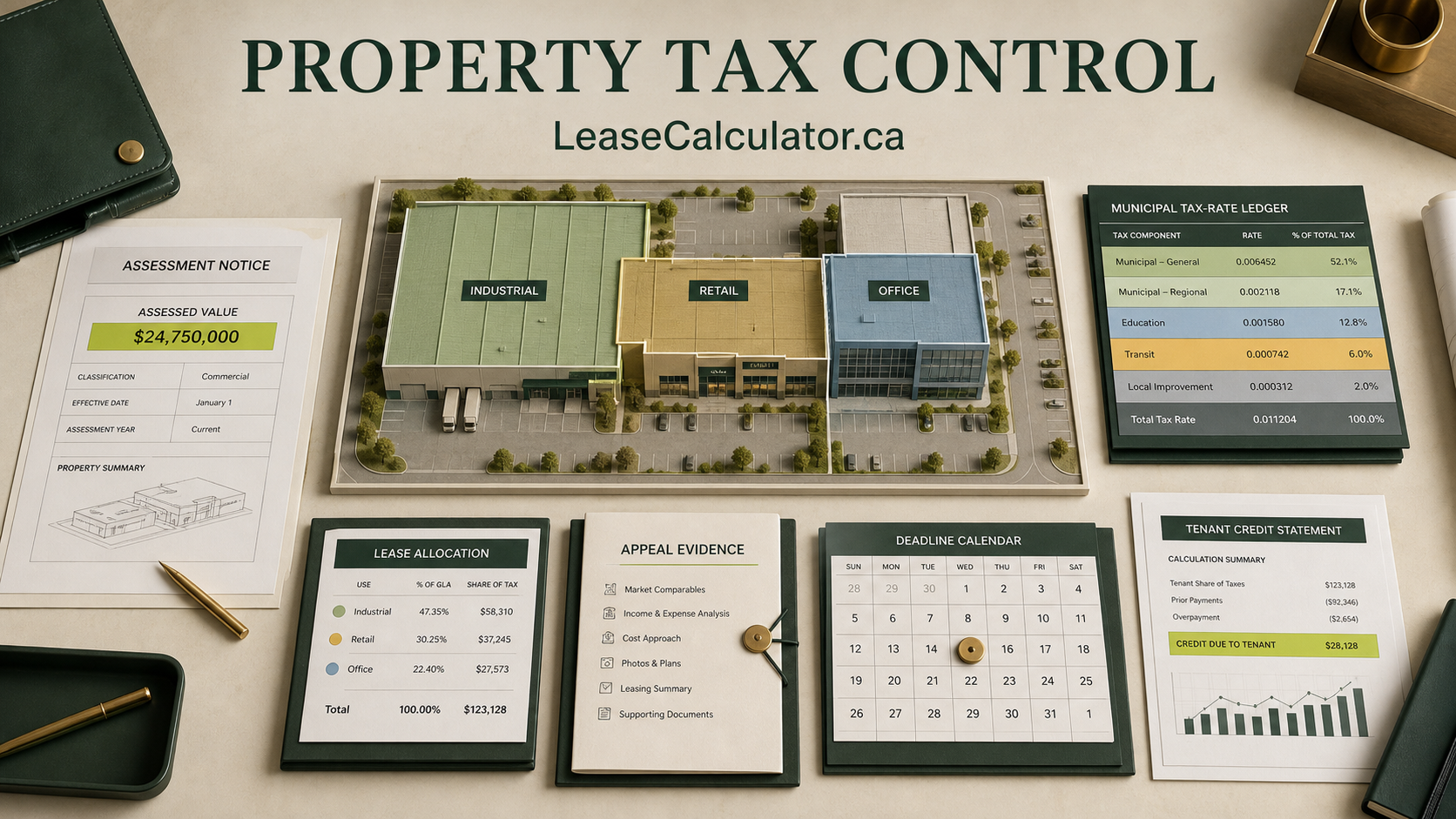
Separate rates, levies, supplementary amounts, local improvements and later adjustments.
Test definitions, exclusions, allocation, direct charges, caps, fees, tax and refunds.
Control authority, deadlines, evidence, cost, decision, true-up, credit and additional charge.
DEVICE-LOCAL PROPERTY TAX CONTROL FILE
From assessment notice to the right tenant charge.
Separate the assessed value, official tax bill, lease recovery rule, appeal process and tenant cash. Every example is editable, and every uncertain source stays visible.
What is being taxed—and what share belongs in this file?
The assessment is for the whole roll. The tenant charge depends on the lease-defined premises, numerator, denominator and any direct allocations.
Plain English
Start by naming the exact property, space and jurisdiction. Then enter the share exactly as the lease defines it. A 10,000 SF tenant in a 100,000 SF building is not automatically a 10% tax share.
01 / 08
Numbers shown: 3 tax components · 1 assessment years · device-local storage only.
Connect the property-tax file to lease administration, transaction advice and qualified assessment review
- Commercial advisory at Commercially.ca
The advisory practice behind this tool, covering occupier and owner lease strategy.
- Work with a Calgary commercial advisor
When a local Calgary advisor is the logical next step on a live requirement.
- Research industrial space on IndustrialLeasing.ca
Warehouse, flex and distribution space research for Canadian industrial requirements.