What this means for the deal
- Define the operating baseline before estimating lost revenue or gross margin.
- Separate physical restoration, safe re-entry, operational recovery and financial recovery milestones.
- Model retained revenue, avoided cost, temporary premises and extra expense explicitly.
- Treat insurance status as supported, uncertain, not supported or not reviewed—not simply yes or no.
- Match the interruption model to books, forecasts, mitigation records and policy review without presenting it as a claim entitlement.
- Preserve a decision log for temporary occupancy, reopening, termination and longer-term relocation.
A business-interruption model begins before the interruption
Set the pre-event operating baseline using the organization’s approved records and planning basis. Capture monthly revenue, seasonality, gross margin, payroll and other continuing costs, occupancy cost, production or service capacity, customer channels, critical equipment, staff dependencies, inventory, suppliers and contractual commitments. Preserve the source period and owner for every material input.
Avoid treating revenue as loss. Start with the entered revenue that would reasonably have been expected, subtract revenue retained through unaffected channels or recovery operations, apply the entered gross-margin basis where appropriate, and separately track avoided and additional costs. Accounting and insurance methods may use different definitions; reconcile them rather than forcing one figure to serve every purpose.
| Input | Question | Source |
|---|---|---|
| Expected revenue | What would the business have earned absent the event? | Approved budget, forecast and historical records |
| Retained revenue | What continued online, off-site or at reduced capacity? | Sales channel and operations records |
| Gross margin | Which variable costs move with lost sales? | Reviewed management accounts |
| Avoided cost | Which costs stopped or declined? | Payroll, utilities, procurement and operating records |
| Extra expense | What was spent to reduce interruption or restore capacity? | Approved purchase orders, invoices and rationale |
The building, lease, business and insurance timelines will rarely match
The building clock covers stabilization, investigation, design, repair, commissioning and authority release. The lease clock covers notices, estimates, restoration periods, rent-treatment dates, elections and effective dates. The business clock covers temporary processes, staff, inventory, customer recovery and capacity ramp-up. The insurance clock covers notice, information requests, adjustment, coverage review, advances and settlement.
Place all four on one calendar while preserving their distinct source and meaning. A physical repair estimate is not necessarily the lease restoration period, operational recovery date or insurance period. Mark critical dependencies and show when a date is planned, contract-derived, authority-directed, insurer-requested or actually completed.
Temporary occupancy is an operating design, not just another rent line
Compare remote work, reduced operation, split shifts, contract production, alternate fulfillment, temporary premises, shared space, equipment rental and relocation. For each option, record usable capacity, implementation time, one-time cost, recurring cost, duplicate occupancy, permits, insurance, technology, security, logistics, accessibility, customer impact and exit cost.
Identify which option preserves the most gross margin and critical relationships for the entered cost and risk. Document who approved it and why. A continuity expenditure may be operationally valuable even if insurance recovery is uncertain; conversely, expected insurance should not replace cash-flow planning or spending authority.
- Confirm the temporary use and occupancy are permitted by property and public approvals.
- Check utilities, power, loading, parking, security, accessibility and technology—not only area.
- Model startup and exit costs as well as monthly occupancy cost.
- Record capacity and retained-revenue assumptions with an owner and review date.
- Keep temporary premises separate from a permanent relocation decision.
Separate coverage evidence from recovery assumptions
Build separate records for property, business-income, extra-expense, contingent interruption, equipment breakdown, flood, sewer backup, cyber, crime and other potentially relevant coverage. Record insurer, policy, insured entity, premises, period, limit, sublimit, deductible or waiting period, notification, broker and adjuster contacts, reservation or position, requested evidence and status. Do not infer coverage from a certificate or one summary page.
For modelling, use explicit states: not reviewed, supported by entered review, uncertain or disputed, and not supported. Apply a recovery amount only to a supported scenario and preserve its timing separately from loss. The policy, endorsements, exclusions, cause, facts, mitigation, valuation method and insurer’s position determine the actual claim path.
| Status | Meaning in the workspace | Next action |
|---|---|---|
| Not reviewed | No current policy analysis supports the assumption | Collect the complete policy and route review |
| Supported | Entered policy review supports using the scenario | Preserve source, reviewer, limit and timing |
| Uncertain/disputed | Material condition, exclusion, cause or amount remains unresolved | Track positions and requested evidence |
| Not supported | Do not include the recovery in the model | Plan liquidity and preserve reconsideration rights if applicable |
Make every interruption assumption visible month by month
Project baseline revenue over the entered horizon using the entered monthly change assumption. Record the percentage of revenue retained during interruption and recovery. Calculate the resulting revenue shortfall, then apply the entered gross-margin ratio if that is the selected management model. Add temporary premises, continuity and emergency costs; subtract avoided operating costs; and show modelled insurance receipts in their entered months.
Keep contract rent and reviewed rent treatment on the same schedule so the business can see whether rent relief, if supported, actually offsets interruption and continuity cost. Include repair funding and any termination or replacement-occupancy scenario. Discounting can support comparison but should not obscure the undiscounted monthly cash requirement.
Record what the team did, what it cost and what it protected
Maintain a chronology of calls, inspections, access requests, emergency work, vendor instructions, temporary measures, customer communication, staff redeployment, inventory movement, supplier alternatives and reopening decisions. Link every major cost to its purpose, approval, invoice and expected effect on downtime or loss. Preserve rejected options and the reason they were not practical.
Do not delay urgent life-safety or property-protection action while building a perfect commercial record. As soon as practical, reconcile actions to authority direction, lease notice, insurer reporting, internal authority and procurement controls. Protect personal and confidential information in photos, staff records, customer information and claim material.
Re-entry, reopening and full recovery are three different gates
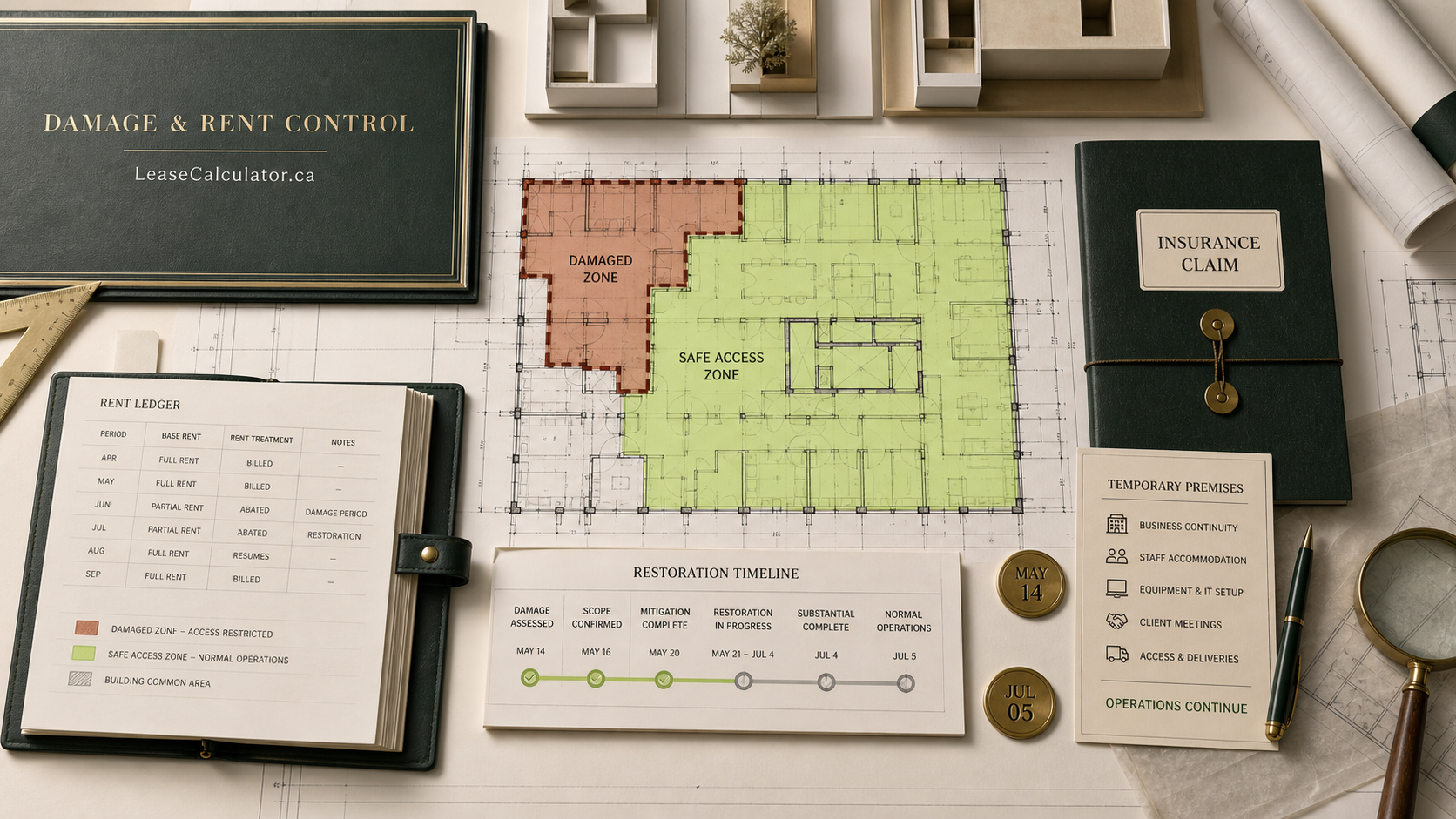
Re-entry can mean limited escorted access for inspection or retrieval. Reopening can mean customers or staff may return under defined restrictions. Full recovery can mean the business reaches its planned operating capacity, but customer demand and supply conditions may take longer. Define each gate and preserve the competent source or internal approval required for it.
Before reopening, reconcile current authority and professional direction, utilities and life-safety systems, environmental clearance where relevant, landlord and contractor status, permits, insurance conditions, accessibility, inventory or equipment, staff readiness, customer communication and lease notices. Track residual defects and temporary measures after reopening instead of closing the file at the first day of trade.
- State the exact areas and hours released for use.
- Record capacity restrictions and temporary controls.
- Preserve commissioning, clearance and inspection records.
- Confirm who owns remaining repair and deficiency items.
- Update rent, claim and continuity assumptions when actual reopening differs from plan.
Give leadership one view without flattening uncertainty
The executive view should show current safety and access state, estimated and actual restoration milestones, capacity path, contract and reviewed rent, lost-margin scenario, temporary and continuity cost, repair funding, supported insurance scenarios, liquidity need, critical dates, unresolved issues and next decisions. Each number should link to its source or assumption.
Export a dated monthly schedule, review brief and portable working file from the Damage & Rent Control workspace. Place approved outputs in the organization’s controlled accounting, property, claim or document system. Preserve prior versions when a source, estimate, coverage position or decision changes.
Frequently asked questions
Is lost revenue the same as a business-interruption loss?+
No. Revenue, gross margin, continuing and avoided costs, extra expense, policy definitions and forensic or accounting methods are different. Use the workspace for a transparent management scenario and obtain qualified review for a claim or financial statement.
Should expected insurance proceeds be used to fund recovery?+
Only as a clearly timed and supported scenario. Coverage, amount and payment timing can remain uncertain, so maintain a liquidity plan that does not silently assume prompt recovery.
What is extra expense?+
In general business terms, it is an additional cost incurred because of the interruption, often to continue or restore operations. Whether and how it is covered depends on the complete policy and facts.
How should temporary premises be compared?+
Compare timing, usable capacity, one-time setup, recurring occupancy, duplicate rent, equipment, staffing, logistics, approvals, insurance, customer impact and exit cost—not rent alone.
When is the interruption over?+
Use separate physical, safe-access, reopening and operating-capacity milestones. The lease, management plan, accounting model and insurance policy may each use a different period.
What evidence should be preserved?+
Preserve incident and authority records, photos, inspections, lease and policy sources, notices, access decisions, estimates, invoices, purchase orders, payroll and sales records, forecasts, mitigation decisions, temporary-premises files, communications and reopening evidence subject to privacy and document-control rules.
Where the factual guidance comes from
These links support narrow factual points in this guide. They do not replace review of the proposal, executed lease or advice for the actual transaction.
Canadian Centre for Occupational Health and Safety — Emergency Response Planning Guide ↗Official Canadian resource addressing emergency planning and recovery; use current workplace, authority and professional instructions for the event.Public Safety Canada — A Guide to Business Continuity Planning ↗Government of Canada catalogue entry for business-continuity planning guidance; adapt planning to the organization and current risk environment.Insurance Bureau of Canada — Types of business insurance coverage ↗General Canadian consumer information on business insurance, including business interruption; the actual policy and endorsements control coverage.Canadian Centre for Occupational Health and Safety — Floods and the workplace ↗Official hazard and workplace guidance relevant to flood preparation and response; follow competent local direction for the actual site.This guide is general educational information and financial-workflow support. It is not legal, tax, accounting, engineering, environmental, appraisal or brokerage advice. Verify source documents and obtain appropriate professional advice before acting.