What this means for the deal
- Put life safety, authority direction and qualified building assessment ahead of lease or rent analysis.
- Record the event, each affected area, access status and source before describing the premises as usable or unusable.
- Read casualty, repair, access, insurance, rent, termination, default, force-majeure and notice provisions together.
- Model base rent, additional rent and other recurring charges separately instead of applying one blanket percentage.
- Treat a modelled abatement or termination date as a scenario until the right, conditions and process are reviewed.
- Preserve estimates, invoices, photos, professional reports, authority records, notices and approvals in one dated evidence ledger.
The first decision is whether anyone should enter—not whether rent stops
Follow the property emergency plan and instructions from emergency services, public authorities, the landlord or property manager, and qualified building, environmental, electrical, mechanical or restoration professionals. Do not use lease wording, insurance expectations or business urgency to overrule a safety restriction. Record who made each access decision, when it was made, what area it covered and what evidence supports it.
Create two tracks immediately. The safety-and-stabilization track controls people, utilities, hazards, access, emergency work and authority communication. The lease-and-business track preserves notices, repair responsibility, rent questions, insurance reporting, continuity options and decision dates. The tracks should share facts without allowing an unreviewed commercial assumption to become a safety instruction.
Replace one broad incident label with a sourced area-by-area record
A fire, flood, vehicle impact, structural concern, smoke event, service failure, environmental condition or public taking can affect different parts of a property differently. Record date and time, discovery, suspected cause without assigning blame, emergency attendance, authority file numbers, utilities affected, life-safety systems, access controls and immediate stabilization work. Mark disputed or unknown facts as such.
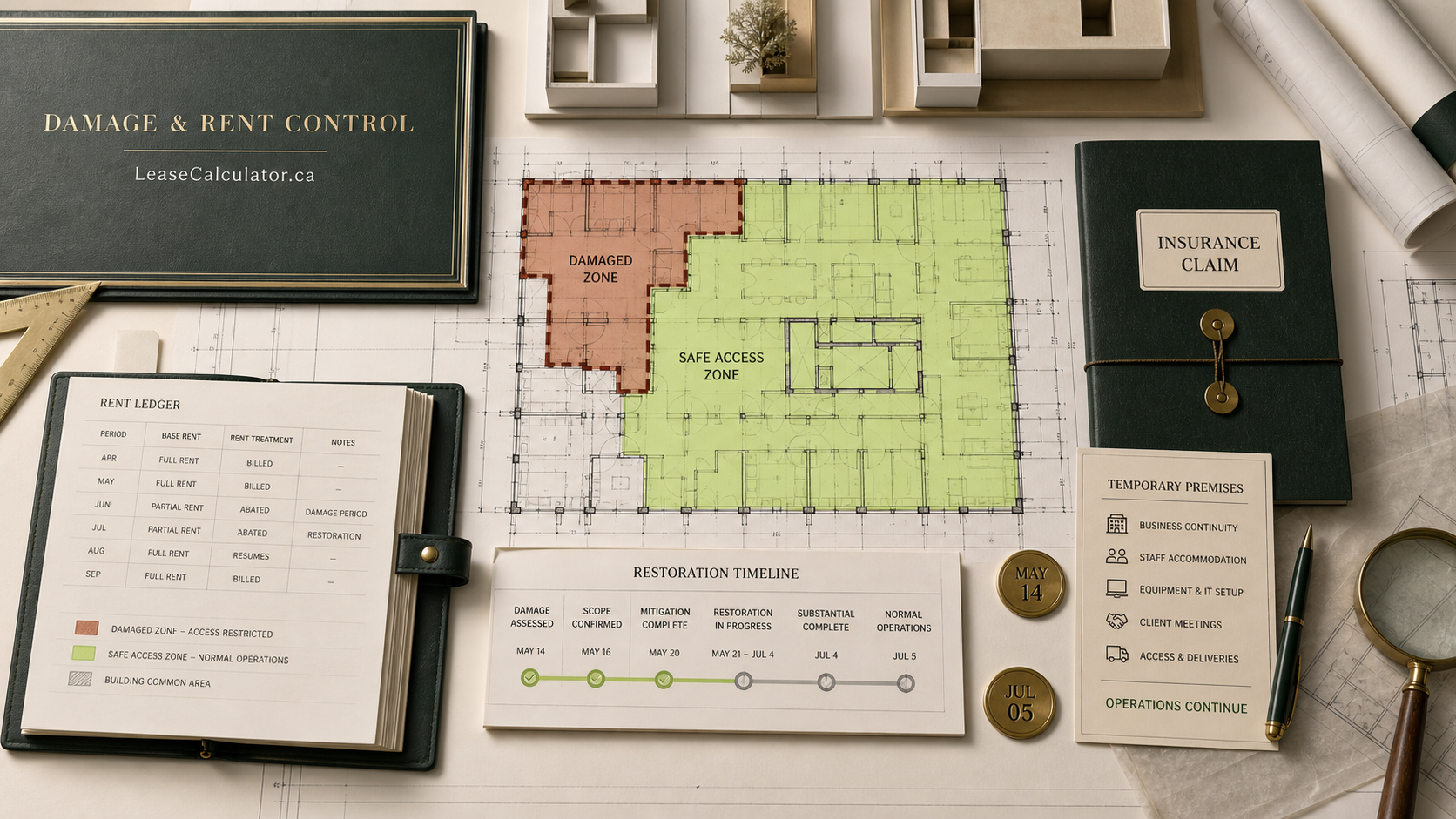
Map the premises, common areas, loading, parking, access routes, building systems, storage and any critical operating zone. For every area, record whether it is available, restricted, unavailable or unknown; whether access is open, escorted, prohibited or awaiting direction; the current repair scope; the responsible party under review; and the source date. Revisit this map whenever conditions change.
| Field | Plain-language question | Evidence |
|---|---|---|
| Condition | What is damaged, contaminated, disconnected or under investigation? | Photos, incident record and professional report |
| Use | Can this exact area support the permitted operation? | Operations review and current inspection |
| Access | Who may enter, under which restrictions and on whose authority? | Authority or qualified-professional direction |
| Repair | What emergency, base-building and tenant work remains? | Scoped estimate and responsibility review |
| Date | When was this status last verified? | Dated source and named owner |
The casualty paragraph rarely answers the problem by itself
Extract the damage or destruction provision, then map repair and maintenance, access, services, insurance, indemnity, rent and additional rent, termination, force majeure, default, notices, expropriation or condemnation, restoration, alterations and lender provisions. Check every amendment, schedule and work letter. Definitions such as premises, building, project, material damage, substantial destruction, restoration period and insured damage can change the result.
For each possible right or duty, capture the trigger, decision-maker, evidence standard, estimate process, notice method, cure or restoration period, outside date, election window, continuing obligations and consequence. Keep the contract summary separate from counsel’s interpretation and from the business team’s chosen scenario.
- Who performs emergency work, base-building repair and tenant-property repair?
- Who selects, approves and pays contractors, consultants, permits and temporary protection?
- Does the clause address physical damage, inability to access, service interruption or only one of them?
- Which rent components continue, reduce, defer or require later reconciliation?
- Who may terminate, after which estimate or period, and through which notice process?
- Do insurance proceeds change an obligation, timing condition or payment flow under the actual wording?
Rent abatement is not necessarily one percentage applied to one total
Build the contract-rent baseline first, including independent escalation dates for base rent and additional rent. Then create a reviewed scenario for each component: percentage payable, fixed monthly amount, amount per square foot, or another entered treatment. Record the start month, end month, review status and source reference. Do not infer that taxes, operating costs, utilities, storage, parking, percentage rent or other charges follow base rent.
A usable-area percentage can support operational analysis but does not by itself create the lease formula. Physical damage, safe access, material interference, use of the premises and the lease-defined abatement test may differ. Preserve any invoice, credit note, reservation of rights, payment under protest, accounting treatment and later true-up separately from the model.
| Component | Model separately | Do not assume |
|---|---|---|
| Base rent | Contract escalation and entered treatment period | That physical damage automatically changes payment |
| Additional rent | Estimate, reconciliation and entered treatment | That it follows base rent |
| Utilities/services | Actual service, metering and responsibility | That an outage eliminates every charge |
| Parking/storage | Availability and separate agreement terms | That premises treatment controls ancillary rights |
| Percentage rent | Sales definition, reporting and entered alternative | That closure resolves reporting or calculation |
One completion date hides the decisions that usually cause delay
Separate stabilization, investigation, design, approvals, procurement, landlord work, tenant work, commissioning, authority sign-off, access release and operational reopening. Give every milestone an owner, source, planned date, actual date, dependency and current status. Mark an estimate as an estimate; do not convert it into a legal deadline unless the lease or reviewed notice does so.
Maintain a cost range by affected area and responsibility state. Distinguish emergency cost, building repair, tenant improvements, contents, professional fees, permits, code-related work, debris removal, environmental work, security, temporary services and betterment. Reconcile the repair budget with the insurance file without treating insurance coverage as proof of contractual responsibility.
- Preserve pre-incident condition and maintenance evidence where available.
- Record emergency authorization separately from final scope approval.
- Track long-lead equipment, permit and utility dependencies explicitly.
- Document scope changes, hidden conditions and disputed betterment.
- Define what physical completion, substantial completion, access and operational reopening each mean.
A termination scenario is a decision path—not an automatic conclusion
If the lease contains damage-related termination language, capture who may exercise it, the triggering estimate or condition, affected property, excluded causes, notice deadline, effective date, withdrawal or cure rules and treatment of rent, insurance proceeds, improvements, property, restoration and possession. Review lender, franchise, financing and guarantee consequences before an election is made.
Compare continuation and termination on the same time horizon. A termination scenario may include shutdown, removal, restoration, professional fees, replacement premises, temporary occupancy, duplicate rent, deposits, new improvements, moving, technology, permits and lost margin. The economic comparison supports a decision; it does not establish that a contractual or statutory right exists.
Canadian commercial lease outcomes are document- and province-specific
Commercial lease statutes and private-law rules vary by province and territory. Québec’s Civil Code contains lease obligations and remedies within a civil-law framework. Common-law provinces have their own statutes, case law and contractual approaches. A taking or expropriation also raises a different statutory process from ordinary casualty damage, and compensation or rent consequences cannot be generalized across Canada.
Preserve the property province, governing-law clause, complete executed lease package, land interests, authority records and current official sources. Route questions about entitlement, enforceability, notice, frustration, termination, expropriation, remedies and statutory override to qualified counsel in the applicable jurisdiction.
The useful output is a controlled recovery file—not a confident paragraph
The working file should contain the event chronology, current safety and access direction, area map, source-linked clause map, repair-responsibility matrix, milestone schedule, estimate range, component-specific rent scenario, notices, invoice treatment, insurance status, interruption model, decision log and unresolved issue queue. Every material statement should have an owner, as-of date and source status.
Use the Damage & Rent Control workspace to assemble and export the working record. Store approved outputs in the organization’s controlled document or claim system. Reopen the file when access changes, a new estimate is issued, rent is invoiced, coverage is confirmed or denied, a milestone slips, a notice is sent, or an election is made.
Frequently asked questions
Does rent automatically stop when commercial premises are damaged?+
Do not assume so. The complete lease, amendments, facts, affected area, use and access condition, notice process, jurisdiction and potentially other law must be reviewed. Model each rent component only as an entered scenario until the position is supported.
Can usable floor area be used as the abatement percentage?+
It can be one operational input, but it may not be the lease test. The wording may use other concepts or conditions, and different rent components may be treated differently.
Who decides whether the premises are safe?+
Follow current direction from the competent public authority and qualified building, environmental, electrical, mechanical or restoration professionals. A lease calculator and the business team should not self-certify safety.
Does insurance coverage decide who must repair?+
Not by itself. Insurance coverage, contractual repair responsibility, cause, negligence, cost allocation and payment mechanics are separate questions that must be reconciled using the actual documents and facts.
When should a termination scenario be modelled?+
As soon as the complete lease suggests a possible right or the restoration horizon threatens the business plan. Keep the model clearly labelled as a scenario until the trigger, notice, timing and legal effect are reviewed.
What should be updated most often?+
Safety and access status, affected-area condition, restoration milestones, cost estimates, invoice treatment, coverage status, temporary operations and decision dates should be updated whenever new verified evidence arrives.
Where the factual guidance comes from
These links support narrow factual points in this guide. They do not replace review of the proposal, executed lease or advice for the actual transaction.
Canadian Centre for Occupational Health and Safety — Emergency Response Planning Guide ↗Official Canadian emergency-planning resource covering prevention, preparedness, response and recovery; use current authority and professional instructions for the actual site.Government of Alberta — OHS Code, Part 7: Emergency Preparedness and Response ↗Official Alberta workplace emergency-preparedness requirements; confirm current application to the workplace and event.Civil Code of Québec ↗Official consolidated Civil Code; Québec civil-law analysis requires the current text, complete documents and qualified review.Ontario — Expropriations Act ↗Official Ontario statute relevant to expropriation; do not generalize its process or consequences to ordinary casualty events or other jurisdictions.This guide is general educational information and financial-workflow support. It is not legal, tax, accounting, engineering, environmental, appraisal or brokerage advice. Verify source documents and obtain appropriate professional advice before acting.