Premises, online, delivery, catering, gift cards, taxes, returns and exclusions.
SALES DEFINITION · REPORTING · BREAKPOINTS · TRUE-UP · AUDIT CONTROL
“Gross sales” is a lease definition.
Rebuild every reporting period, show which revenue is included, test each claimed deduction, calculate the entered breakpoint or tier structure and reconcile the rent paid—without hiding the evidence or pretending the calculation is an audit opinion.
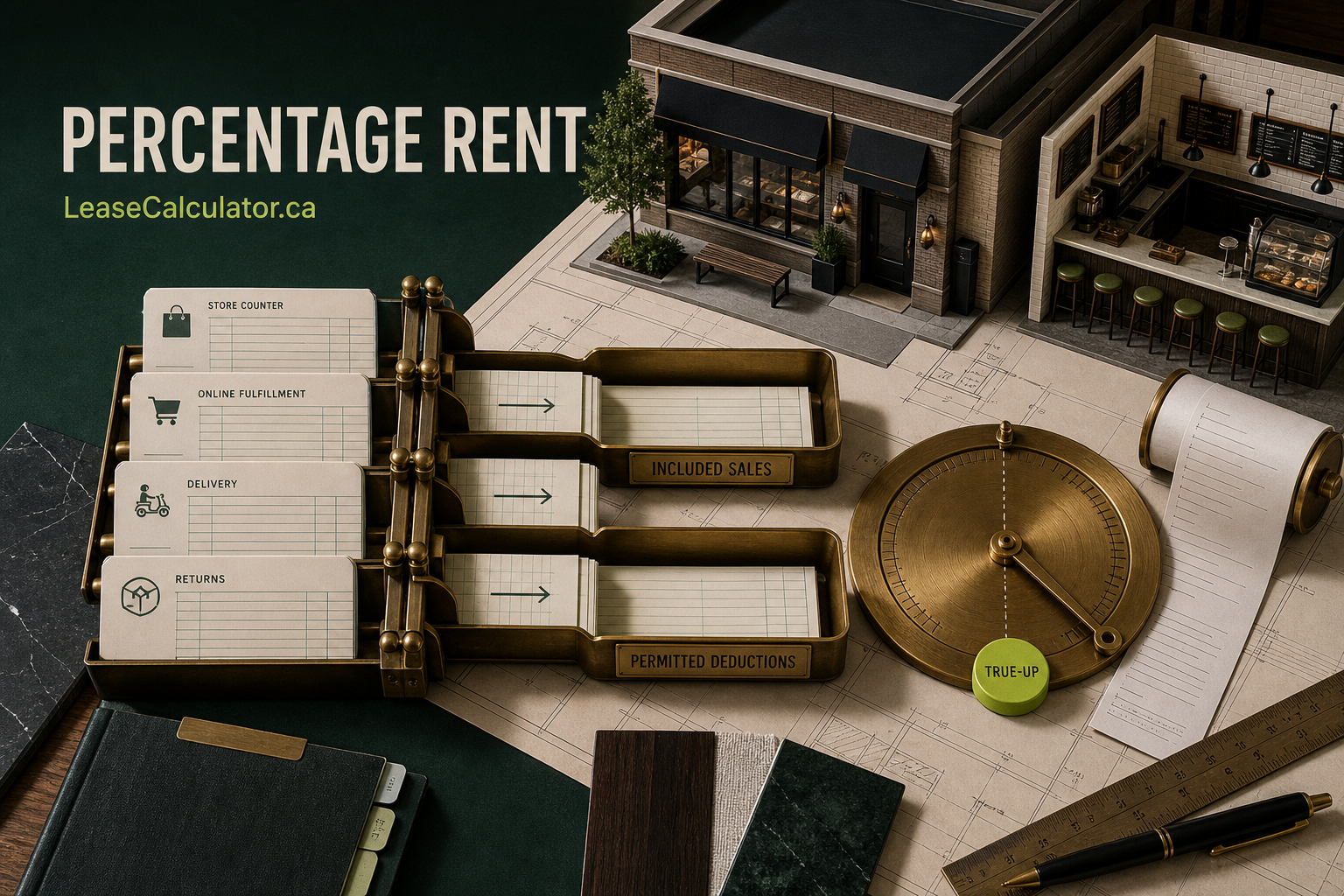
Keep raw sales, deductions, adjustments, reports and source status separate.
Entered or natural breakpoint, gross less base, tiers, proration, minimum or cap.
Certification, confidentiality, records, notices, objections and audit deadlines.
DEVICE-LOCAL PERCENTAGE-RENT & SALES EVIDENCE WORKBENCH
Rebuild the sales statement before calculating the rent.
Every amount, treatment and source stays visible. Nothing is uploaded by this workbench.
Saved on this device
START WITH A CONTROLLED EXAMPLE
Choose the formula that resembles the lease—then replace every illustrative field.
01 · CONTROL THE FILE
Which lease, premises and reporting year are being reconciled?
These fields identify the file. They do not prove the lease term or sales period.
02 · VERIFY THE OPERATIVE CLAUSE
The lease definition controls. The calculator does not.
Preserve the exact source, amendment chain and professional interpretation before closing a reconciliation.
03 · DEFINE THE RENT FORMULA
Make the breakpoint, credit, proration and limits explicit.
The workbench supports three arithmetic structures. The selected label is not a legal conclusion.
PRORATION1.000×Annual amounts unchanged
PERIOD FACTOR1.000×365 calendar days entered
04 · TRANSLATE THE SALES DEFINITION
For each bucket: what goes in, what comes out and why?
The percentages below control the arithmetic. A deduction at 100% subtracts the full entered amount; a positive-sales row at 100% includes the full amount.
ADDSales made at the premises
ADDOnline / omnichannel sales attributed here
ADDCatering, delivery or marketplace sales
ADDOther potentially included revenue
DEDUCTReturns and refunds
DEDUCTSales taxes collected
DEDUCTGift-card or stored-value adjustment
DEDUCTEmployee discounts / allowances
DEDUCTOther entered exclusions
05 · REBUILD EACH SALES PERIOD
Keep raw sales, claimed deductions and evidence separate.
Open a period to enter the detailed ledger categories, reporting dates and source record.
2026-01-01 → 2026-03-31
Q1
GROSS $613,000DEFINED $553,000
reviewedSource not reviewedCalculated sales used80% source record
2026-04-01 → 2026-06-30
Q2
GROSS $674,000DEFINED $608,000
reviewedSource not reviewedCalculated sales used80% source record
2026-07-01 → 2026-09-30
Q3
GROSS $630,000DEFINED $570,000
not dueSource not reviewedCalculated sales used80% source record
2026-10-01 → 2026-12-31
Q4
GROSS $840,000DEFINED $755,000
not dueSource not reviewedCalculated sales used80% source record
06 · RECONCILE RENT AND TAX
See exactly how reported sales become the proposed true-up.
Tax is deliberately separate. Enter only an accountant-approved GST/HST rate and paid-amount basis.
Reported gross sales$2,757,000
Positive sales included by definition$2,757,000
Permitted deductions− $271,000
Signed adjustments+ $0
Defined sales used$2,486,000
Effective breakpoint− $2,000,000
Percentage rent before limits$29,160
Calculated percentage rent$29,160
Other signed rent adjustment$0
Paid / accrued amount− $12,000
True-up before tax$17,160
ENTERED RENT TAX$1,458Shown separately
TRUE-UP WITH ENTERED TAX$18,018Entered amount payable
07 · STRESS THE SALES CASE
What changes if defined sales move—but the lease formula does not?
This is sensitivity, not a sales forecast. Fixed costs, formula, breakpoint, limits and paid amount remain unchanged.
| Scenario | Defined sales | % rent before limits | Calculated % rent | Total occupancy cost | Cost / sales | True-up before tax |
|---|---|---|---|---|---|---|
| -20% sales | $1,988,800 | $0 | $0 | $190,800 | 9.59% | -$12,000 |
| -10% sales | $2,237,400 | $14,244 | $14,244 | $205,044 | 9.16% | $2,244 |
| Entered defined sales | $2,486,000 | $29,160 | $29,160 | $219,960 | 8.85% | $17,160 |
| +10% sales | $2,734,600 | $44,076 | $44,076 | $234,876 | 8.59% | $32,076 |
| +20% sales | $2,983,200 | $58,992 | $58,992 | $249,792 | 8.37% | $46,992 |
ENTERED OCCUPANCY COST$219,960Base + additional + other + percentage rent
COST / DEFINED SALES8.85%Not an industry benchmark
08 · CONTROL REPORTING, AUDIT AND NOTICE RIGHTS
The cash result is only one part of the file.
Capture the procedural requirements without assuming what the clause means or whether a remedy is available.
Connect the sales reconciliation to lease administration and professional review
- Commercial advisory at Commercially.ca
The advisory practice behind this tool, covering occupier and owner lease strategy.
- Research industrial space on IndustrialLeasing.ca
Warehouse, flex and distribution space research for Canadian industrial requirements.
- Work with a Calgary commercial advisor
When a local Calgary advisor is the logical next step on a live requirement.