What this means for the deal
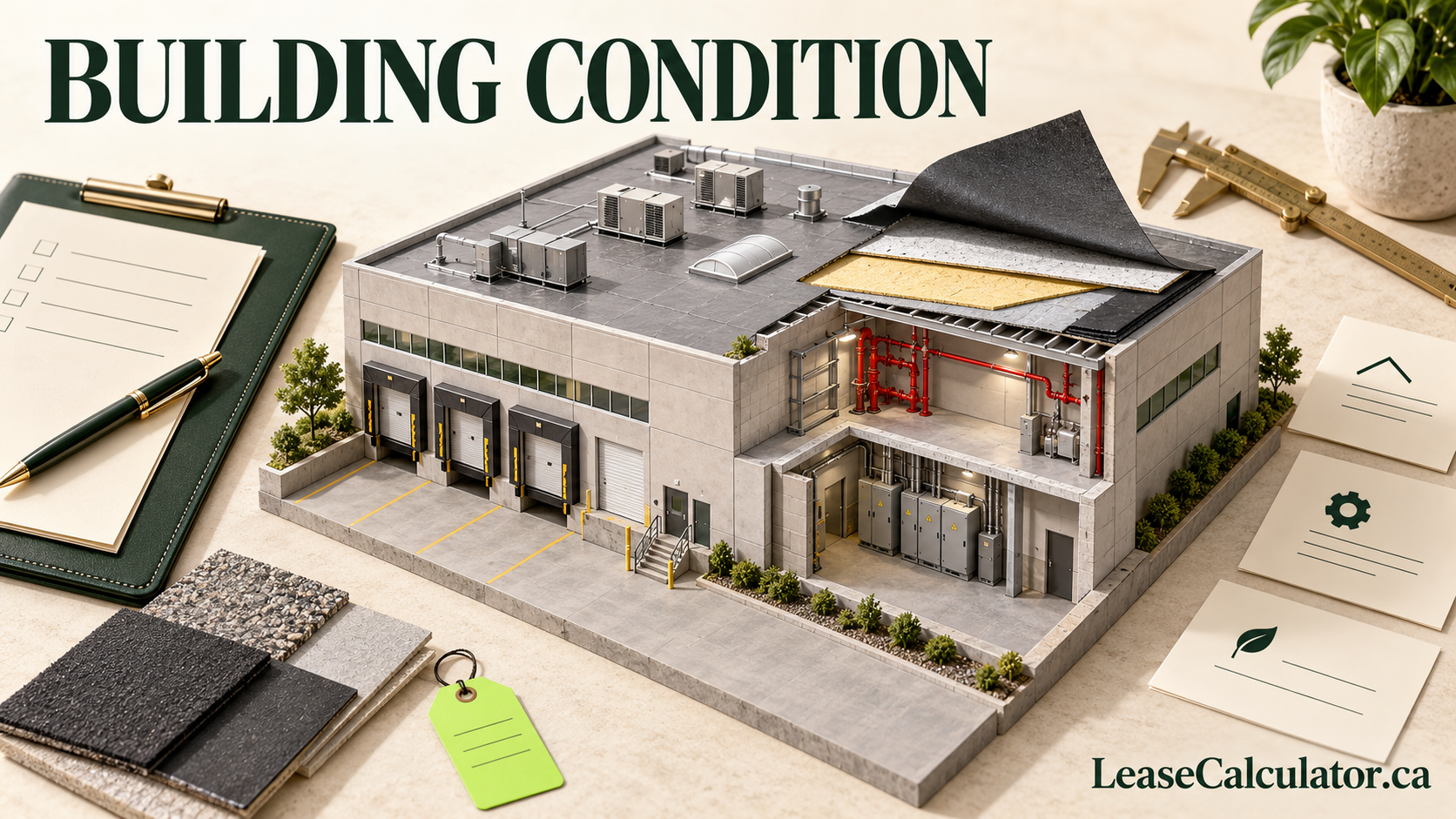
- Start with the systems that could interrupt your business or require significant spending: roof, structure, heating and cooling, electrical, plumbing, loading and life-safety systems.
- Record maintenance, repair and replacement responsibility separately. A promise to service equipment does not, by itself, settle who buys its replacement.
- Keep who arranges the work separate from who initially pays and whether any amount may be charged back to a tenant.
- Use qualified reports and equipment-specific instructions. A building's age, a tour or a green status label cannot establish remaining service life or safe condition.
- Give every open issue a named owner, a next action and a date. Keep the evidence needed to close it.
- Carry approved amounts into lease costs, operating-cost review and capital planning without counting the same bill twice.
Use the guide for the decision you need to make
You tour a warehouse. The roof looks fine, but the heating unit is old and nobody can find the service records. You do not yet know whether the landlord will repair it, whether you must replace it, or whether the cost will turn up in additional rent. A useful condition review turns that uncertainty into specific questions before you commit money.
If you are a tenant, use the review before signing, renewing or accepting possession. If you are a landlord or manager, use it to schedule work, explain budgets and avoid responsibility gaps. If you are buying a building, use it to test the capital assumptions in your acquisition model. The same asset record can support all three decisions, but each role needs a different approval.
| Your role | Ask first | Leave with |
|---|---|---|
| Tenant | What am I accepting, and what might I have to pay? | Condition evidence, lease questions and an occupancy-cost range |
| Landlord / manager | What work is due, and who is accountable? | An action list, service schedule and funded capital plan |
| Buyer / asset manager | What spending is missing from the property model? | A reviewed capital schedule with timing, ranges and sources |
| Facilities team | Which instructions and records govern the next task? | A system-specific schedule and escalation contact |
List the actual systems—not just 'the building'
Create one record for each system or meaningful group of assets. Separate the main roof from an addition with a different installation date. Separate a tenant-only rooftop unit from a central plant serving the whole property. For each record, identify its location, area served, quantity, equipment identifier if available, installation source, service provider and report reference.
Tailor the list to your business. An industrial review might include dock equipment, yard drainage, slab condition and power capacity. An office review might include central heating and cooling, elevators and controls. Retail may need storefront, extraction, grease-management or tenant equipment review. These are scoping prompts, not a statement that every property needs every inspection.
- Roof, exterior walls, windows, doors, foundations and structure.
- Heating, cooling, ventilation, controls and any shared plant.
- Electrical distribution, plumbing, drainage and tenant-specific services.
- Loading doors, dock equipment, yard, paving, parking and access.
- Fire and life-safety systems, elevators and other regulated equipment within the qualified review scope.
- Tenant improvements and equipment whose ownership or removal obligations need confirmation.
Do not put three different obligations in one box
For planning purposes, maintenance means ongoing work intended to keep a system functioning, such as servicing or cleaning under the applicable instructions. Repair addresses a defect or failure. Replacement means replacing an asset or major component. The same system can need all three over a lease term.
These working labels do not determine the legal, tax or accounting classification. Read the actual lease language and obtain the appropriate review. A clause about keeping equipment in repair may interact with replacement, capital-cost, compliance, casualty or tenant-caused damage clauses elsewhere. Do not decide liability from a single word or a template label.
| Work | Illustrative task | Question to resolve |
|---|---|---|
| Maintenance | Scheduled service and cleaning | Who orders it, how often and who keeps the record? |
| Repair | Fix a failed component | Who approves and pays; does the cause change the answer? |
| Replacement | Replace the unit | Who funds it; can any cost be recovered over time? |
The landlord doing the work does not settle the tenant's bill
Keep four entries for each kind of work: who arranges it, who initially pays, what tenant contribution is being modelled and which lease source supports that contribution. The landlord may manage a shared service contract while tenants pay permitted allocations. A tenant may maintain its dedicated unit while replacement remains a separate question. Both are possibilities to verify, not standard rules.
For any proposed recovery, check included and excluded costs, allocation pools, direct charges, capital amortization, interest, useful-life wording, management fees, caps, notice and audit rights. Record the exact executed clause and amendments. A property manager's invoice, a contractor's quote or an accounting capital label is not itself permission to charge a tenant.
Resolve the expensive unknowns before accepting the space
Ask for available condition reports, recent work history, service contracts, warranties, inspection records and outstanding recommendations for systems relevant to your use. Agree what additional qualified review is needed, who may arrange access and whether the proposed lease includes a condition or delivery protection. Missing records are a reason to investigate, not proof that a system has failed.
Connect the review to the business plan. Can the building accommodate the intended occupancy, loading, hours, equipment and service demand? Who pays for the changes your use requires? Have qualified advisors resolve technical capacity, permitted use, code, accessibility, environmental and legal questions. Put the agreed work, evidence, timing and approval conditions into the actual transaction documents.
- Identify the systems your business depends on and any dedicated equipment.
- Request records and ask what was excluded from the latest review.
- Price the unresolved work as a range instead of using zero.
- Confirm required delivery work, completion evidence and responsibility for delay.
- Compare the resulting tenant cash with the lease term and renewal or relocation options.
Make the next action obvious to the person doing the work
A list of assets is only useful if it becomes a work programme. For each open item, state the next action, responsible person, target date, access requirement, approval needed and record that will show completion. Separate an instruction to obtain a report from an instruction to authorize construction. Give a contractor the approved scope rather than only the budget number.
Keep occupants informed about access, shutdowns and disruption through the agreed process. Preserve service reports, findings, invoices, warranty information and completion or commissioning records in your controlled document system. When the result changes the replacement estimate or the next service date, update the asset record and the budget together.
A tour, a condition report and a safety inspection are not interchangeable
Ask what the reviewer examined, how, when and with what limitations. A visual review may exclude concealed areas, destructive testing or performance measurements. Record inaccessible areas and recommended specialist work explicitly. Do not turn an observation into a certification the reviewer did not provide.
CCOHS explains that workplace inspection schedules depend on the jurisdiction, equipment, operations and risk. Some regulated equipment requires qualified or competent inspection at specified intervals. NRC explains that provinces and territories, and some municipalities, adopt and enforce the applicable building and fire regulations. Confirm the requirements with the responsible authority and qualified advisors rather than choosing a universal annual interval.
An HVAC service plan should match the system and the workplace
Health Canada's office-building guidance recommends a preventive maintenance programme and a documented process for resolving indoor-air concerns, including professional help where needed. Its scope is non-industrial, non-residential workplace settings such as offices; it is not a complete industrial ventilation design standard. Changes in occupancy or activities belong in a qualified review.
ESDC's HVAC guidance describes qualified-person instructions for operation, inspection, cleaning and maintenance, with records. Its regulatory requirements are directed to federally regulated employers and systems under their control. Provincial workplace requirements and the actual equipment instructions must be checked separately. A lease allocation does not replace an employer's applicable health-and-safety obligations.
- Keep the relevant qualified instructions and equipment manuals with the system record.
- Record the service dates and findings—not only that a contract exists.
- Give occupants a clear contact and reporting process for concerns.
- Ask qualified reviewers about changed use, occupancy or ventilation needs.
An old asset is not automatically due for replacement
Keep installation date, observed condition, report date, expected next work and replacement timing as separate facts. Age alone cannot establish remaining service life. Usage, environment, maintenance, design, past repair and the review scope can matter. Use a qualified, asset-specific estimate and preserve its assumptions and range.
If no reviewed timing exists, mark it unknown and create an action to obtain advice. For budget sensitivity you may enter an earlier and later spending date, but label them as planning assumptions. Do not present a template's year, a generic equipment-life table or a calculator result as an engineering finding.
A quote is only comparable when you know what it includes
Record the priced scope, quantity, quote date, validity, exclusions and whether the amount includes design, permits, access equipment, demolition, disposal, temporary service, testing, commissioning and tax. Separate known work from allowances and contingency. Two quotes with different exclusions should not become a simple lowest-price choice.
Show low, planning and high amounts where uncertainty is real. Preserve the reason for the range: unresolved scope, concealed work, unpriced access or another stated issue. Keep business disruption separate if it is not in the construction price. Update the range when qualified investigation or competitive pricing resolves an uncertainty.
Leave the review with a work list and a money list
In the Building Condition & Capital Plan workspace, start with an illustrative property template or your own assets. Replace the example systems, amounts, dates, responsibilities and evidence with the real file. First identify what needs review. Then record the approved work and cost timing. Finally test whether the planned funding is enough when the money is needed.
Use the review brief to ask the landlord, tenant, contractor or advisor focused questions. Carry the relevant approved tasks into Lease Obligations and Due Diligence. Review proposed tenant charges in Operating Cost Reconciliation and place approved capital in the property underwriting model. Exports and browser storage are working records, not a professional condition report or your organization's official document repository.
Frequently asked questions
Does a net lease mean the tenant pays for every repair and replacement?+
Do not decide from the label. The complete executed lease, amendments and facts determine the obligations and any permitted recovery. Maintenance, repair, replacement, structural work, capital recovery and tenant-caused damage may have different treatment.
Can the calculator tell me whether the roof or HVAC is safe?+
No. It organizes your entered observations, reports, responsibilities, work and costs. It does not inspect a building, diagnose equipment, certify safety, determine compliance or establish remaining service life.
What should I do if the service records are missing?+
Record the gap, request the records and ask a qualified reviewer what investigation is appropriate. Do not treat missing records as proof of failure or assume that there is no future cost.
Does every system need an annual inspection?+
There is no single interval suitable for every system. Confirm applicable jurisdictional requirements, equipment instructions, use and risk with qualified people. Enter the actual first date and recurrence rather than relying on a template.
Can the landlord charge a roof replacement through operating costs?+
That needs review of the actual lease, including capital inclusions, exclusions, allocation, amortization, interest and caps. The fact that work was necessary or booked as capital does not itself establish a tenant charge.
What does a condition label such as 'needs review' mean?+
It is a planning label entered by the user. Keep the underlying report, date, reviewer, scope and recommended action beside it. A label is not a professional opinion or permission to continue using an unsafe asset.
Where the factual guidance comes from
These links support narrow factual points in this guide. They do not replace review of the proposal, executed lease or advice for the actual transaction.
CCOHS — Effective Workplace Inspections ↗Primary Canadian workplace-safety guidance on inspection planning, jurisdiction-dependent frequency, qualified inspection and corrective-action follow-up. Not a property-condition certification standard.CCOHS — Workplace Housekeeping: Basic Guide ↗General workplace guidance explaining that a maintenance programme includes inspection, maintenance, upkeep and repair. Apply the actual site's requirements and qualified procedures.NRC — Provincial or territorial ministries ↗Official explanation of provincial, territorial and some municipal authority over building and fire regulation. Confirm the adopted local code and current requirements for the property.Health Canada — Indoor air quality in office buildings ↗Final guidance published September 2025 for office and other non-industrial, non-residential workplaces. Supports preventive maintenance, issue resolution and qualified professional involvement within that scope.ESDC — HVAC system maintenance and cleaning ↗Official qualified-person maintenance and record guidance; the stated regulatory obligations apply to federally regulated employers. It is not a universal provincial or lease allocation rule.This guide is general educational information and financial-workflow support. It is not legal, tax, accounting, engineering, environmental, appraisal or brokerage advice. Verify source documents and obtain appropriate professional advice before acting.